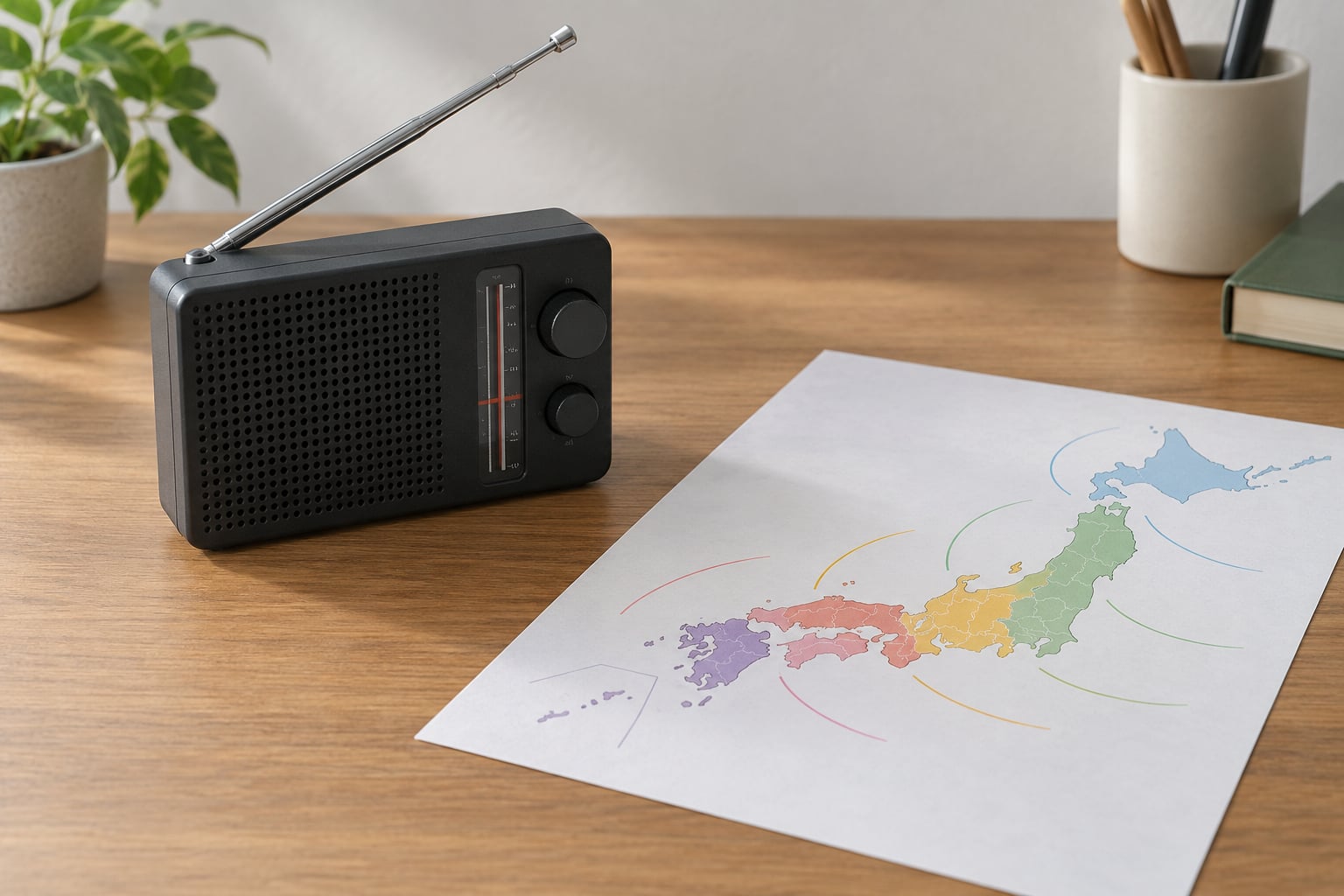
If you bring a radio home from Japan, the first thing you notice is that stations you know have vanished from the dial. That usually is not a fault. The radio was built for Japan’s frequency plan, and Japan applies that plan region by region rather than with one national list.
Table of Contents
- 1What Is the Short Answer?
- 2How Does Japan’s Radio Frequency System Work?
- 3Why Do Japanese Radios Need Frequency Changes?
- 4Why Does the Same Station Have Different Frequencies?
- 5Why Do Japanese Radios Need Frequency Changes After a Transmitter Move?
- 6Why Do Japanese Radios Need Frequency Changes During Digital Broadcasting Changes?
- 7What Should You Do If a Japanese Radio Stops Receiving a Station?
- 8How Can You Find the Correct Frequency in Japan?
- 9Frequently Asked Questions
- 10What radio frequency does Japan use?
- 11Why does the same station have a different frequency in different parts of Japan?
- 12Why can my Japanese radio still pick up a few stations between 88 and 90 MHz?
- 13Can I change a Japanese car radio to work on 88-108 MHz?
- 14Do Japanese ham radios and shortwave receivers have the same restriction?
- 15Is Radiko available outside Japan?
- 16Start by Checking the Regional List
What Is the Short Answer?
Japanese broadcast frequencies are assigned by region, so the same service can appear on different FM or AM frequencies in different parts of Japan. Changes also follow transmitter relocations, network reorganisations, and the move away from legacy analog broadcasting.
In plain terms, a preset list is a snapshot of who is licensed to broadcast in one prefecture. When the licensing map changes and your radio’s list does not, the radio looks broken while it is behaving exactly as built.
One thing to clear up early: Japan’s 50 Hz mains frequency is a completely separate question from radio frequencies. It comes up in the same search results because Japan is unusual in both respects, but one has nothing to do with the other and nothing to do with which stations your radio can hear.
How Does Japan’s Radio Frequency System Work?
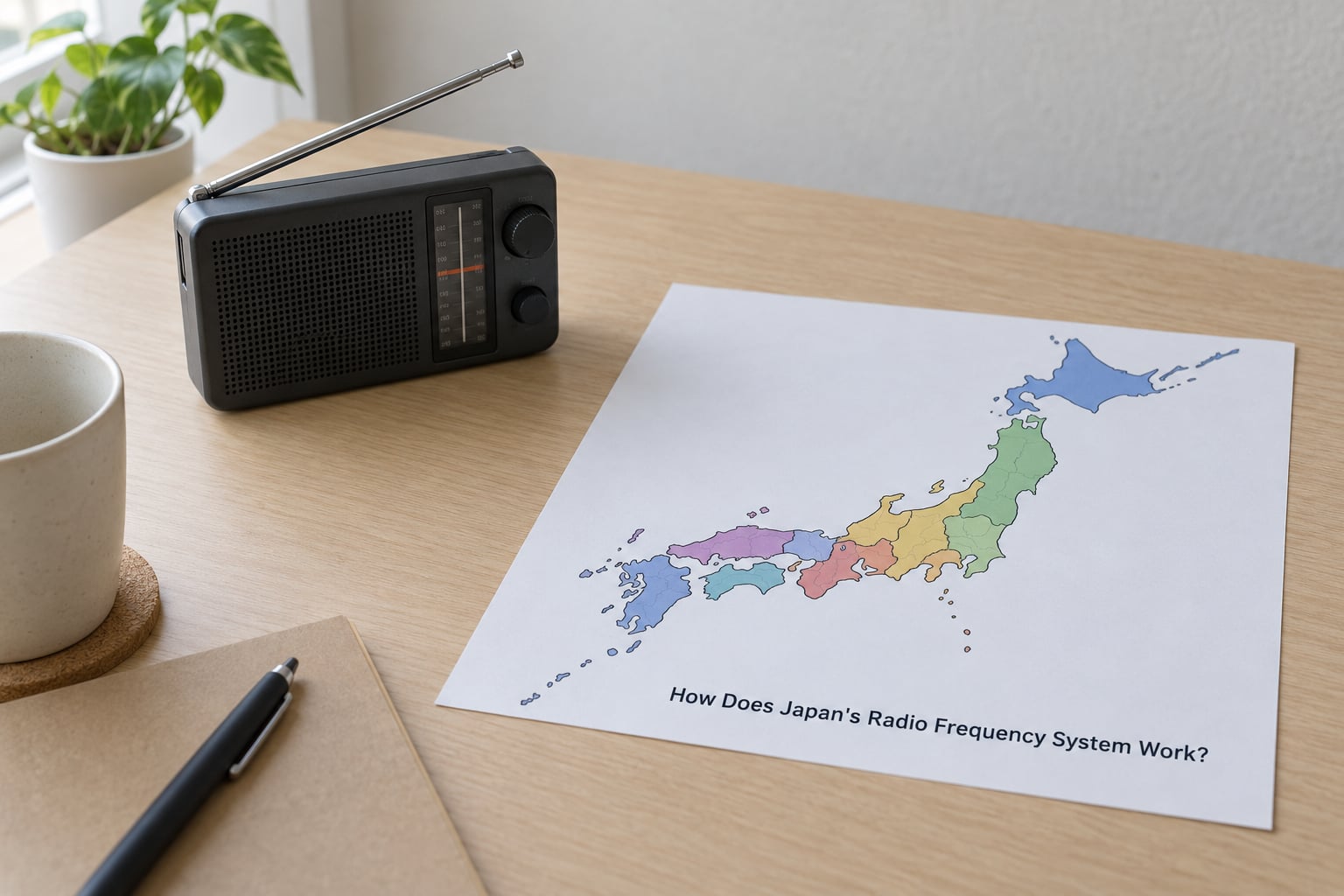
The Ministry of Internal Affairs and Communications assigns broadcast frequencies, and it does so to protect existing services from interference rather than to give broadcasters the freedom to pick any clear channel. A station gets a channel in a defined area, and that channel belongs to it in the plan.
Japanese FM broadcasting sits at 76 to 90 MHz, with additional channels up to 95 MHz for community and educational stations. North America, Europe and Australasia start at 87.5 or 88 MHz and run to 108 MHz. The two plans barely overlap.
| Region | FM lower limit | FM upper limit | Channel spacing |
|---|---|---|---|
| Japan | 76 MHz | 90 MHz (95 MHz for community stations) | 200 kHz |
| United States and Canada | 87.5 MHz | 108 MHz | 200 kHz |
| Europe | 87.5 MHz | 108 MHz | 100 or 125 kHz |
| Australia and New Zealand | 87.5 MHz | 108 MHz | 100 to 200 kHz |
That table explains the most common surprise for travellers. A Japanese-market tuner has an RF front end and a 10.7 MHz intermediate frequency filter built for the Japanese plan, so it can typically receive only a couple of megahertz of the international band before the signal falls into the filter’s stopband. That is why listeners report picking up a handful of stations between 88 and 90 MHz and nothing above it.
AM is set up differently again. Japan uses the medium wave from 525 to 1605 kHz with 9 kHz channel spacing, where North America uses 10 kHz. A preset written for one plan will not land on the same channel in the other, even when both stations share a call sign or a network name.
Presets are stored per band plan, and many devices ship with several regional tables. If a radio has a region, zone or area setting, that setting changes which preset list loads, not which frequencies the hardware can tune. General coverage and the underlying tuner stay the same.
Why Do Japanese Radios Need Frequency Changes?
Japanese radios need frequency changes for a handful of ordinary, boring reasons. None of them signal a problem with your equipment.
- Regional licensing. The Ministry of Internal Affairs and Communications assigns each broadcaster a channel for a specific service area, so the same service can hold different frequencies in different prefectures.
- Transmitter relocation. Moving a main transmitter to a different site can change both the coverage footprint and the assigned channel.
- Interference management. When two transmitters start overlapping, the regulator can move one of them to another channel rather than let the interference continue.
- Network reorganisations. Mergers, affiliations and station closures leave stale presets behind on every radio that had the old entry saved.
- Migration off analog services. Many analog AM and, in some areas, analog FM services have been reorganised or replaced, so a frequency that used to carry a station now carries something else or nothing at all.
- Outdated preset databases. A radio bought years ago carries the list that shipped with it. Preset databases age faster than most people expect.
The recurring thread is simple. Assignment changes are made by the regulator, and your radio only finds out about them when its list is refreshed or you enter the frequency yourself.
Why Does the Same Station Have Different Frequencies?
Because a frequency is a licence with an address attached. A station that broadcasts to a wide area is licensed to cover one area, so you may hear a relay or a co-channel station on a different number as you travel, and the frequency you use to reach a network service from one prefecture may not be the right number from the next one.
In practice this shows up in three ways. A preset saved at home may not exist where you are staying, a manual entry may be needed because the correct channel is not in the list, and a network service may appear on a different channel depending on the region you are in.
Station-by-station assignments also change over time, so treat any list you find as a record of one moment rather than a permanent truth. Verify against the current regional list published by the station or the regulator before you assume a number is wrong.
Why Do Japanese Radios Need Frequency Changes After a Transmitter Move?
A transmitter move changes the physics before it changes the paperwork. The new site sits in a different place, sees a different ground pattern and reaches a different set of listeners, so the coverage map that justified the old channel no longer holds.
Once the regulator reassigns a channel, listeners in the overlap zone hear both the old and new transmission, or one that cuts out where the two sites fight each other. Receivers do not adapt on their own. The station moves, the listener’s preset stays where it was, and reception drops until somebody updates the number.
Modern radios with network-connected preset updates can pick this up eventually. Everything else needs you to do it: re-scan, add the new frequency manually, or delete the entry you no longer need.
Why Do Japanese Radios Need Frequency Changes During Digital Broadcasting Changes?
Analog and digital broadcasting are separate services that can sit in different parts of the spectrum. Japan uses ISDB-T for digital terrestrial broadcasting, while DAB+ is the digital standard used across much of Europe. Neither replaces an analog channel on a receiver that only looks for analog FM.
So a station vanishing from the analog band does not always mean the broadcaster has closed. It may have moved its programming to a digital multiplex, or moved to a community station on a frequency your radio does not scan by default. The station still exists and still broadcasts, just not where your device is looking.
Internet distribution is the other half of the story. Streaming services carry the same programming without a frequency at all, which is why a service can be available to you while the analog channel it once used is being reassigned.
What Should You Do If a Japanese Radio Stops Receiving a Station?
Work through this in order and you will usually find the cause in a few minutes. The order matters, because each step rules out something the next one assumes.
- Check the region setting. If the radio has a region, zone or area menu, confirm it matches where you are. Menus differ by model, so look for a setup or tuning menu rather than guessing.
- Re-scan for presets. A scan is faster and more reliable than trusting entries stored months ago.
- Find the current official frequency. Check the station’s own page or the current regional list before assuming anything is wrong.
- Enter the frequency by hand. If the station transmits at that number, a manual entry will pick it up even when the preset is stale.
- Check the antenna. A telescopic whip that is not fully extended, or a headphone antenna lead, changes reception more often than people expect.
- Test on another device. A second radio or a frequency counter tells you whether the problem is the station or your equipment.
- Consider the band plan. If you are outside Japan with a Japanese-market tuner, you may simply be outside its coverage.
If the station is missing from the official list and does not appear when you enter its published frequency by hand, then the hardware is worth investigating. Until then, you are debugging a database, not a circuit.
How Can You Find the Correct Frequency in Japan?
There are four reliable ways, and they are worth using in this order.
- Official Japanese broadcast lists. The regulator and broadcasters publish current channel allocations, and this is the only source that settles a disagreement.
- Your radio’s regional preset function. On devices with a region or zone menu, switching the area reloads the list for that prefecture.
- The station’s own website. Most Japanese broadcasters list their frequency prominently on a page aimed at listeners.
- On-air announcements. Station IDs and frequency announcements exist precisely so travelling listeners can retune.
Check current information every time, because assignments and services do change. A list you saved last year is a starting point, not an authority.
Frequently Asked Questions
What radio frequency does Japan use?
Japanese FM broadcasting uses 76 to 90 MHz, with additional channels up to 95 MHz for community and educational stations. North America, Europe and Australasia use 87.5 or 88 to 108 MHz. Japanese FM channels are spaced 200 kHz apart, and AM runs from 525 to 1605 kHz with 9 kHz spacing. That is why a Japanese tuner and an international tuner overlap only around 88 to 90 MHz.
Why does the same station have a different frequency in different parts of Japan?
Because a frequency is licensed together with a service area. The Ministry of Internal Affairs and Communications assigns each broadcaster a channel for a defined region, so a wide-area network can be licensed on different channels in different prefectures. As you travel, a preset saved in one region may not exist in the next, which is why travellers add stations manually rather than relying on the stored list.
Why can my Japanese radio still pick up a few stations between 88 and 90 MHz?
A Japanese-market tuner is built for 76 to 90 MHz, but its RF front end and 10.7 MHz intermediate frequency filter still pass some signals a little beyond the assigned band. That gives you roughly 2 MHz of overlap with the international band, usually 88 to 90 MHz. Above that, the filter rejects the signal and reception collapses, which is a design limit rather than a fault you can fix with a setting.
Can I change a Japanese car radio to work on 88-108 MHz?
Usually not with a setting. A region or zone menu on a JDM head unit changes which preset list loads, not the range of frequencies the tuner hardware covers. Extending analog reception to 108 MHz means changes to the front end, the oscillator range and often the dial scale, which is why import owners treat it as a hardware project. On a modern digital transceiver a region setting can genuinely widen coverage, so check the manual for that model first.
Do Japanese ham radios and shortwave receivers have the same restriction?
Amateur transceivers built for the Japanese market are often band-restricted by a region setting rather than by fixed hardware, and owners report that changing that region on some Yaesu and Icom models does unlock wider coverage. Analog FM and AM consumer receivers are a different case, because their limits sit in the analog front end. Shortwave sets are usually unaffected above 10 MHz because those allocations follow international agreements.
Is Radiko available outside Japan?
No. Radiko is restricted to listeners within Japan, which is why it often appears in searches about Japanese radio frequencies from people abroad. The service is delivered over the internet rather than over a broadcast frequency, so it has nothing to do with the 76 to 90 MHz band plan. Expat listeners generally rely on a tuner that covers their home country’s FM band alongside Japanese stations.
Start by Checking the Regional List
Most radio problems that look like frequency changes are not. Check the current regional list, confirm your region’s preset setting, re-scan, and enter the published frequency by hand before you suspect the hardware. If the station is on the official list and your radio still cannot find it, then you have a receiver problem worth chasing.
Understanding why Japanese radios need frequency changes takes about two minutes once you know that frequencies belong to regions, that the Japanese FM band runs 76 to 90 MHz, and that a preset list is just a record of one moment in that assignment history.