How Japanese idol merchandise drives sales comes down to one thing: turning a fan’s ongoing emotional investment into a steady stream of scheduled purchases. Groups release new editions on a fixed calendar, sell different versions of the same item so that buying one does not finish the set, and attach every product to a moment a fan wants to remember rather than a utility the product performs.
The result is a business where a single fan might buy six versions of one release across two years, and where the group’s revenue is far less exposed to streaming economics than a Western artist’s. It is also why physical goods still carry weight in 2026 even as digital and virtual products expand.
This is an explainer on the mechanics. If you are tracking the business side of Japanese entertainment from outside the country, the vocabulary matters, so the terms are used as the industry uses them throughout.
Table of Contents
- 1What Is Japanese Idol Merchandise?
- 2What Makes It Different From Celebrity Retail
- 3How Japanese Idol Merchandise Drives Sales
- 41. Releases That Include a Reason to Meet the Member
- 52. Editions That Are Incomplete on Purpose
- 63. Goods That Only Exist at a Venue
- 74. Licensing That Reaches Outside the Fanbase
- 8How the Fan-to-Buyer Model Works
- 9Why Fans Buy More Than One Version
- 10Limited Editions With Different Contents
- 11Serial Numbers And Set Completion
- 12Event Exclusives And Regional Variants
- 13Bonuses That Rotate
- 14Which Products Create the Best Sales Mix
- 15How Memberships Turn Fans into Repeat Customers
- 16How Concerts and Online Shops Work Together
- 17What Data Helps Merchandise Teams Improve Sales
- 18Why Some Strategies Backfire
- 19Overproduction
- 20Scarcity That Is Obviously Fake
- 21Too Many Similar Editions
- 22Thin Quality On The Premium Tier
- 23Pushy Membership Messaging
- 24Letting Resale Pressure Become The Plan
- 25Treating Fans As Transactions Only
- 26Frequently Asked Questions
- 27Why do Japanese idol fans buy multiple versions of the same merchandise?
- 28How does official idol merchandise differ from reseller or fan-made items?
- 29Do limited-edition Japanese idol products always sell better?
- 30What makes idol fan club memberships worth paying for?
- 31How do concert events affect online merchandise sales?
- 32Can independent artists use the same merchandise sales model?
- 33Conclusion: Start With the Repeat-Purchase Loop
What Is Japanese Idol Merchandise?
Japanese idol merchandise is the physical and digital product range an idol group or its management releases under the member names, and it runs from a few hundred yen items up to premium collector boxes. Unlike ordinary celebrity retail, where a small label releases a hoodie once a year, an idol operation publishes a goods calendar that fans can plan around months in advance.
The main categories break down roughly like this:
- Apparel and fan gear — T-shirts, hoodies, jerseys, towels, uchiwa (the round hand-held fan), penlights, and light sticks in colourways that change per release.
- Visual editions — photobooks, making-of DVDs, self-shot photo sets, and the seasonal commemorative sets released around birthdays and anniversaries.
- Music releases and their variants — the CD single itself, plus limited pressings, serial-numbered sets, theatre editions, and the tickets or lottery entries that come attached.
- Accessories and small goods — acrylic stands, keychains, tote bags, pocket tissues, clear files, and trading cards, including random-carded styles that encourage collecting.
- Event goods — items only obtainable at a concert, handshake event, talk event, or seasonal event booth.
- Licensed collaborations — goods built with character brands and with ordinary apparel or convenience company lines.
- Digital and membership goods — streaming access, member-only video, digital photobooks, in-app items, and avatar or virtual concert goods.
What Makes It Different From Celebrity Retail
The difference is the calendar, not the product. A normal merchandise drop is an event. An idol schedule is infrastructure: a fan knows roughly when something will appear, and that predictability is what makes budgeting and repeated buying feel normal rather than impulsive.
It also means a fan’s relationship with a group is expressed through many small purchases rather than one large one. The fan who cannot afford a concert tour can still buy a photobook every quarter, and that person counts commercially in exactly the same ledger.
How Japanese Idol Merchandise Drives Sales
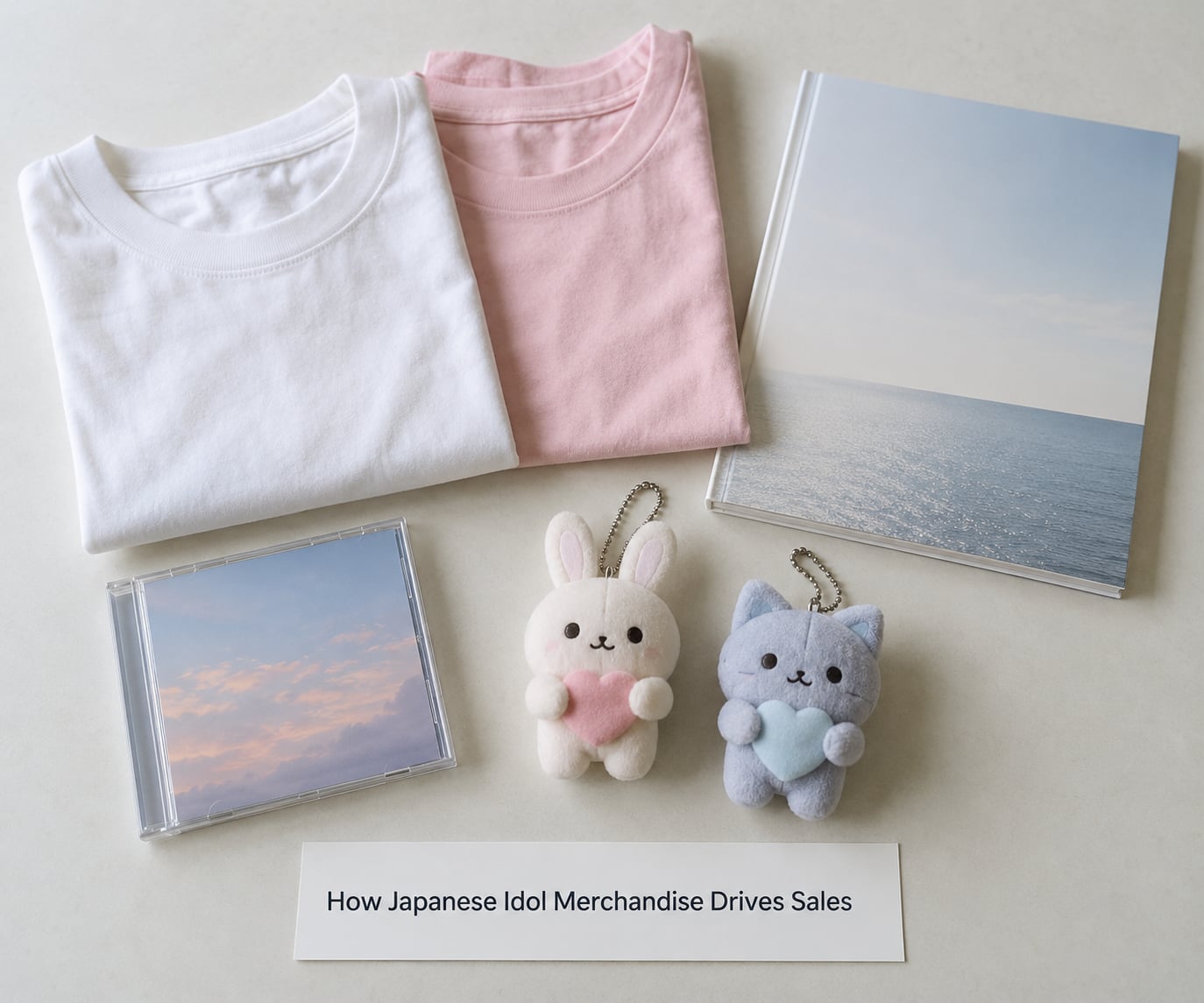
In short, idol merchandise drives sales through four connected drivers: CD-style releases bundled with member interaction, limited visual editions that reward multi-buying, venue-exclusive goods that create urgency, and character or brand licensing that reaches fans beyond the core audience. A regular release rhythm gives fans something to come back for, and a tiered price ladder lets a group capture a small purchase and a large one from the same supporter.
1. Releases That Include a Reason to Meet the Member
A physical single in the idol market is rarely just a song. It commonly comes with a serial or lottery entry for a handshake event, a talk event, or a photo session, and often several bonuses such as a member photo, a trading card, or a limited-edition bonus item. Because the entry is printed inside or bundled with the product, the effective way to secure the interaction is to buy the product, sometimes more than one.
This is the single most important structural trick in the model. The product creates a queue for the experience rather than the experience selling the product, and it converts demand that would otherwise be capped by venue capacity into demand expressed through purchase volume.
2. Editions That Are Incomplete on Purpose
Visual releases are the strongest repeat-purchase engine. A single song often ships as a first press limited edition, a regular edition, a limited edition with different photography, and sometimes a set bundled with a DVD. The contents differ enough that owning one does not cover another, and the numbering on premium sets makes each purchase feel like a distinct object rather than a duplicate.
When a product series is planned rather than improvised, a fan buying a new item at random still has a reason to keep going. The next box closes a gap in the shelf.
3. Goods That Only Exist at a Venue
Concert and event goods do two jobs. They move higher-value items through on-site booths where the audience is already assembled, and they cannot be compared against an online listing, which keeps the price conversation out of the room.
Collectors also treat venue goods as the more durable part of a discography, which means the event channel quietly feeds the resale market and gives buyers a reason to attend in person.
4. Licensing That Reaches Outside the Fanbase
Character collaborations let an idol group sell to people who would not otherwise buy an idol release. A fan who likes the character brand gets a product tied to the group, and the character company gets access to an audience it cannot easily reach. A regular apparel brand or a convenience store line does the same thing with a wider demographic.
For the group, a collaboration is usually a higher-profile product with a wider distribution network and less of the fan-scrutiny problem that comes with asking the same members to sell another identical shirt.
How the Fan-to-Buyer Model Works
The commercial sequence is not a funnel in the marketing sense. It is a loop, and fans describe it as oshikatsu, the word for spending money and time on an idol you follow. The typical path runs through these stages.
- Discovery — short-form clips, variety show appearances, or a recommendation from someone already buying. The first purchase is usually something small and inexpensive.
- Community participation — streaming, voting, joining the fan club, attending a lottery entry system. Participation is what makes the fan a participant rather than a customer.
- First purchase — a photobook or a goods item, often picked up at an event booth where the experience and the product are the same transaction.
- Collection — the fan begins organising what they own, notices the missing editions, and starts planning purchases around the next calendar.
- Sharing and trading — posting purchases, trading duplicate cards, reselling what they have too much of. This is unpaid marketing, and it is also how fans meet each other.
- Repurchase — the next release, the membership renewal, the anniversary set. By now the fan is buying on a schedule rather than on impulse.
It helps to separate what the transaction delivers from what it signals. The transaction delivers a physical object. The signal is membership in a group of people who care about the same members, and that is the part competitors in ordinary retail struggle to copy.
The second part is why sellers in this market describe the buyer as a supporter first and a customer second. A fan who feels their spending counts toward a group’s continued existence spends differently from someone who is comparing two hoodies.
Why Fans Buy More Than One Version
Multi-buying is usually deliberate rather than a failure of self-control, and the design of the catalogue is what makes it rational.
Limited Editions With Different Contents
A first press limited edition and a regular edition may hold the same music but different packaging, different photography, or a different bonus item. They are two objects, so the fan who wants the set buys both. The labels exist to describe press runs, and using them also signals that one of them will not return.
Serial Numbers And Set Completion
Numbered sets reward the buyer who commits early. Number one carries status in a collection, and completing a run turns a consumer into something closer to a registrar. Missing a number at the end of a series is the single most reliable driver of a back-order I have seen fans describe.
Event Exclusives And Regional Variants
A fan who attends a concert can only buy the goods sold at that venue, and fans in different regions sometimes face different items. A buyer who wants a complete record has no choice but to attend more events or find the missing piece later, usually on the resale market at a premium.
Bonuses That Rotate
Random or numbered bonus items mean that buying several copies is the only reliable way to collect them all. Manufacturers use this pattern broadly across character goods, and idols inherit it because the mechanism already works for the audience.
Which Products Create the Best Sales Mix
A healthy merchandise operation needs items at several spending levels, because the fans who buy an impulse accessory rarely overlap completely with the fans who fund a premium collector set.
| Product tier | Role in the mix | Purchase frequency | Margin potential | Main limitation |
|---|---|---|---|---|
| Impulse items and small accessories | Keeps new fans inside the ecosystem and gives them an entry point | Frequent, often monthly | Low per unit, high on volume | Easy to compare with cheaper substitutes elsewhere |
| Apparel and fan gear | Worn in public, so it keeps the group visible between releases | Several colourways per cycle | Moderate | Repeated near-identical designs can annoy buyers |
| Music and photo editions | The core of the catalogue and the anchor for the release calendar | Every cycle | Moderate to high depending on the edition | Manufacturing and shipping costs are real and rise with volume |
| Premium collector sets | Generates the highest value per buyer and drives the secondhand market | Occasional, tied to anniversaries | High | Overproduction turns a premium item into dead inventory |
| Event and venue exclusives | Converts attendance into revenue and creates urgency | Once per event attended | High | Hard to buy without being present in the right place |
| Licensed collaborations | Reaches buyers outside the core audience and lifts perceived value | Occasional | Shared with the licensing partner | Less control over design and timing |
| Digital and virtual goods | Recurring revenue with no physical production cost | Continuous | High, once the audience exists | Weakens the physical collecting habit if it substitutes for it |
The interesting part of this table is the relationship between the first and last rows. Low-cost physical items buy the relationship; digital goods monetise it cheaply once it exists. When a group leans too hard on digital and pulls back from physical, the entry point for new fans tends to narrow.
How Memberships Turn Fans into Repeat Customers
Paid fan club membership is the most predictable line in the whole business, and it is predictable because it renews on its own. Instead of hoping fans come back, management books a recurring commitment and then attaches benefits to it.
What tends to sit behind a membership, roughly in order of how much fans mention it:
- Advance access — members enter sales, lotteries, and event applications before the general public, which removes the anxiety of missing out.
- Member-only goods — an extra item or edition reserved for members, frequently with a number attached.
- Points and purchase credit — small accumulated benefits that make regular buying feel like it is going somewhere.
- Birthday and anniversary goods — targeted, date-driven releases that guarantee an occasion every year for every member.
- Voting rights — members participate in the general election or similar polls, which is a low-cost way to make fans feel the spending had an effect.
- Application and event booking priority — priority access to concerts, talk events, and seasonal events when capacity is limited.
What makes this more than a subscription trick is the vote. A fan who is allowed to influence an outcome treats the renewal as participation, and a fan who is allowed to participate behaves very differently from a fan who is merely offered a discount.
The weakness is equally predictable. A benefit that is hard to obtain at any price protects the membership; a benefit that is easily found elsewhere quietly teaches members not to renew. Shops in this industry have learned that distinction the hard way.
How Concerts and Online Shops Work Together
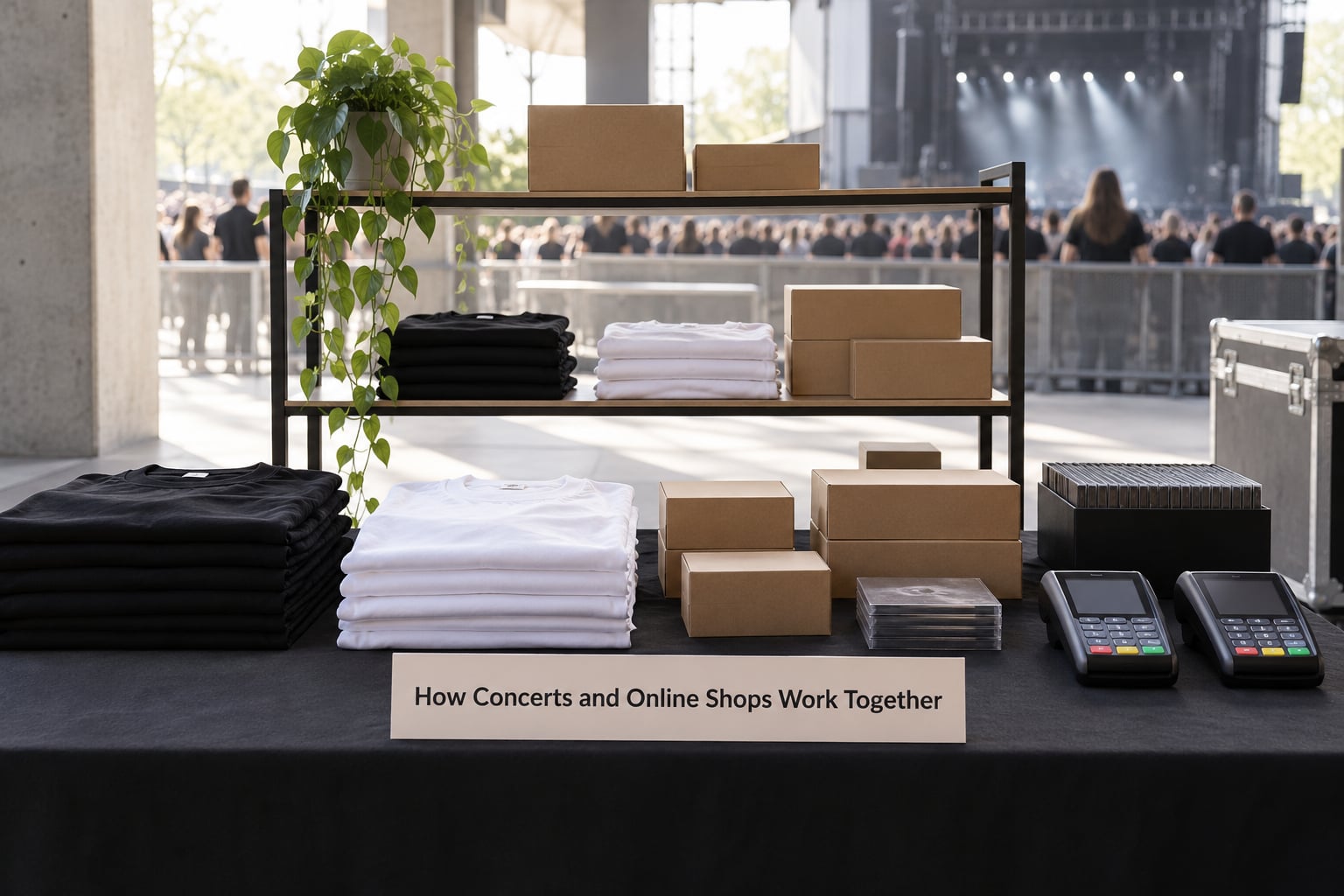
Concert and online sales work as a pair. The event creates urgency and a deadline; the official online store provides reach and a second sales window after the lights go down.
Alongside those two sit several other channels, each with its own behaviour:
- Official online stores and shops — the primary channel, the one with guaranteed authenticity, and usually the only one that carries every variant.
- Venue and event booths — on-site goods, sold to an audience already assembled, with a queue that keeps the impulse purchase rate high.
- Mail order — the standard route for limited editions, where demand exceeds the intended run and access is rationed by lottery or membership priority.
- Group ordering and lottery systems — distribute limited quantities fairly and give the operation a reliable demand signal before production.
- Physical retail partners — record shops, anime and character retailers, and convenience store tie-ins, which place goods in places fans already visit. Convenience store lines in particular tend to be popular because they convert a normal errand into an impulse purchase.
- Resale marketplaces — where fans sell duplicates, complete sets, or pass on tickets they cannot use. This channel is not official, but it is where demand for missed items ends up, usually at a large premium.
For fans outside Japan, the practical friction is real: Japanese shops often require a Japanese address, many popular items are lotteries rather than first-come purchases, and language and payment barriers add friction to every release. That is why buyer services and forwarding services exist as an industry of their own. It is also why overseas buying tends to push fans toward group orders with other buyers, which lowers the cost but adds a wait.
None of that changes the underlying economics. Scarce goods sell better when the scarcity is real, and a deadline that exists only in a press release is the version that stops working.
What Data Helps Merchandise Teams Improve Sales
Merchandise teams work with aggregate numbers, and the useful ones are less exotic than people expect.
- Conversion rate by release — how many visitors to a product page actually buy, compared with the previous release. This is the fastest signal that a new product type is working.
- Repeat purchase rate — the share of buyers who come back for a later release. This is the closest thing to a single score for the whole business, and it improves only when a fan has a reason to return.
- Membership renewal rate — more direct than any campaign metric, because renewal is a decision fans make with their own money.
- Sell-through by product type — how quickly each category sells out. Overproduction usually shows up here first.
- Event-day lift in online sales — whether attendance drives extra purchases afterwards, or whether fans spend everything on the day and go quiet.
- Demand by region and by channel — which areas convert, and how much of the sales come from each distribution route.
- Resale prices for retired goods — a rough, public read on whether fans valued a product more than the team assumed.
The boundary that matters is the collection side. Aggregate purchasing patterns tell a team what to restock. Individual-level tracking of who buys what, in combination with engagement data, turns a fan relationship into a file, and it is the part fans notice and dislike most. The revenue gain from it is usually smaller than the trust cost.
Why Some Strategies Backfire
The same mechanics that make the model work are the ones that break it when applied carelessly.
Overproduction
Overordering a popular item to be safe destroys the scarcity that justified its price and leaves a company with inventory it has to discount. Fix it by producing to a demand signal from the previous comparable release, not to a forecast of how enthusiastic the last one felt.
Scarcity That Is Obviously Fake
Artificial scarcity is easy to spot, and fans compare notes. Once a “limited” edition reappears, every future limited claim loses value, and the discounting starts on the next one. Fix it by publishing quantities and end times so the claim can be checked.
Too Many Similar Editions
Six nearly identical versions of one release makes buyers confused rather than eager, and it produces a wave of people who bought the wrong copy. Fix it with a clear comparison image showing exactly what differs between editions.
Thin Quality On The Premium Tier
Buyers pay more for a numbered set and expect better material and finishing. When a premium item feels thin, the reaction is not just a bad review; the premium tier stops being able to charge a premium. Fix it by putting the quality difference where it is visible, in the box and the physical product.
Pushy Membership Messaging
Renewal pressure and anxious communication about expiring memberships read as a reminder that the money mattered more than the support. Fix it by making membership benefits worth renewing and by being straightforward about dates once.
Letting Resale Pressure Become The Plan
When an operation leaves money on the resale market on purpose, the fans who paid full price end up funding the strategy. Fix it by using lotteries and membership priority to set the rules instead of rationing supply and hoping for a premium secondary market.
Treating Fans As Transactions Only
Over time this shows up as fan communities shrinking while unit numbers hold up, and it shows up first on social media, long before the sales figures move. Fix it by keeping the non-commercial parts of the relationship real: the replies, the event formats, the reason anyone joined in the first place.
Frequently Asked Questions
Why do Japanese idol fans buy multiple versions of the same merchandise?
Because the versions are not identical. A first press limited edition, a regular edition, and a bonus edition often differ in packaging, photography, and included items, so owning one does not cover the others. Numbered sets add a completion goal, and some bonuses are random, which means buying several is the only way to collect them. From the seller’s side, the extra copy is a predictable purchase, not a surprise one.
How does official idol merchandise differ from reseller or fan-made items?
Official goods come from the group or their management through an official store, event booth, or licensed partner, and they carry the group’s own serial numbers, packaging, and announcements. Resold goods are the same product bought second-hand, often at a premium when a limited run sold out. Fan-made items are unofficial creations, and they are sold for different reasons entirely. Checking the seller’s channel and the packaging details separates them quickly.
Do limited-edition Japanese idol products always sell better?
No, and the difference is worth understanding. Scarcity raises the value fans assign to a product, but it does not create demand where none exists. A limited edition of something nobody wants sells slowly at a lower tier than a regular edition of something fans already buy. Limited items work best when the underlying product is already popular and the limit adds a reason to decide now rather than later.
What makes idol fan club memberships worth paying for?
The valuable parts are access and participation rather than discounts. Members commonly get into sales, lotteries, and event bookings before the general public, receive member-only goods, accumulate small credits, and vote in the group’s general election. That last one matters more than it sounds: fans who can influence an outcome treat renewal as participation, which is far stickier than a price incentive.
How do concert events affect online merchandise sales?
Events raise online sales in a few different ways. Attendance proves the group is active, so fans who skipped the show buy something afterwards to participate at a distance. Venue-exclusive items create a second wave of demand from fans who could not attend and want the missing piece. And event goods that hold their value in the resale market give buyers a reason to keep attending in person.
Can independent artists use the same merchandise sales model?
Yes, most of the model has no dependency on scale. A regular release calendar, tiers of products at different price levels, and something worth collecting will work for a small audience. The parts that do not transfer are the ones tied to capacity: handshake events, lotteries, and venue exclusives only create value when demand genuinely exceeds supply. Independent artists usually get the same repeat-purchase effect from editions and bundles instead.
Conclusion: Start With the Repeat-Purchase Loop
Japanese idol merchandise drives sales because the product is designed to be bought again, and because the relationship that produces the purchase is renewed on a schedule. Editions that are incomplete on purpose, releases that carry a reason to attend, goods that exist only at a venue, and memberships with real access attached all point at the same loop: buy, collect, return.
If you are studying this from the outside, the first thing to examine is not the product range. It is whether there is a believable reason to come back after the first purchase. Groups with a real calendar and a real reason to return twice a year do not need clever tactics. Groups without one sell the same T-shirt and wait.