Japan’s ebook market is fragmented because publishing rights are sold store by store, and every store wraps those titles in its own app, file format, account system and payment rules. To be precise about why Japanese ebook stores are fragmented: there is no single national catalogue, no shared library, and no way to move a purchased book from one service to another.
That sounds like a design flaw until you look at how it happened. The split is the accumulated result of decisions made by device makers in the 2000s, publishers protecting print revenue, and corporations that each built their own distribution channel.
I have read across three of these services without ever finding a title that moved between them, which is the part that still surprises people coming from Amazon.
Table of Contents
- 1What Fragmented Means in Japan’s E-book Market
- 2Why Japanese E-book Stores Are Fragmented
- 3Device Ecosystems Split the Reader Market
- 4How Device Ties Create Different Marketplaces
- 5Specialized Stores Serve Different Reader Needs
- 6Manga and Digital Comics Shape Store Identity
- 7Publishing Rights and Release Models Keep Catalogs Separate
- 8Pricing, Formats, and Payment Systems Add Friction
- 9Platform Strategy, Not Reader Taste Alone, Drives the Divide
- 10Why Japanese E-book Stores Are Fragmented Compared With Other Markets
- 11What Fragmentation Means for Readers, Authors, and Marketers
- 12Frequently Asked Questions
- 13Is there one dominant ebook store in Japan?
- 14Why are manga and comics sold through separate Japanese apps?
- 15Can you transfer a purchased ebook from one Japanese store to another?
- 16Why are some Japanese books available in print but not as ebooks?
- 17What should foreign publishers consider when selling ebooks in Japan?
- 18Conclusion
What Fragmented Means in Japan’s E-book Market
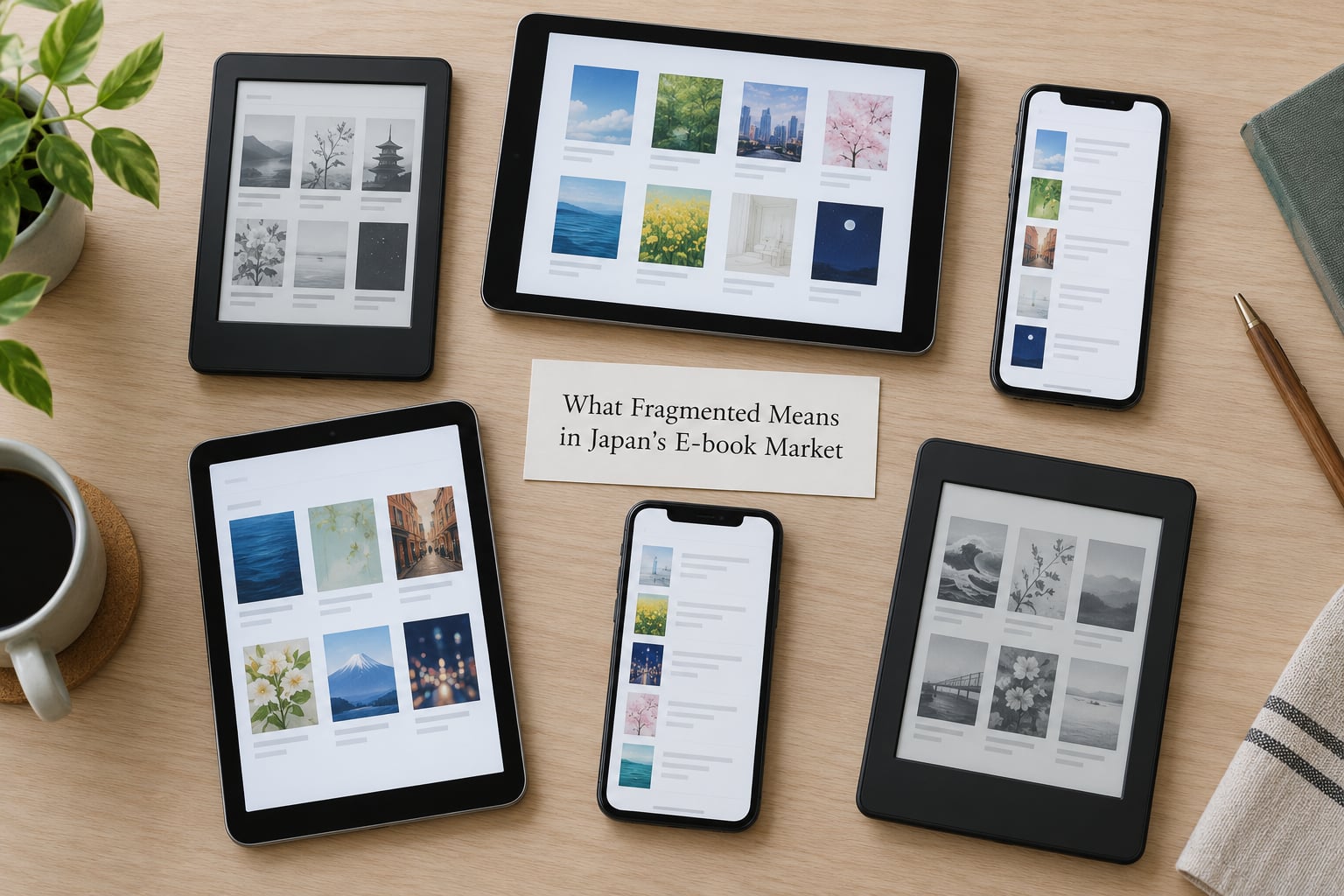
Fragmented means a reader meets several separate marketplaces instead of one. Each has its own catalogue, its own app, its own login, its own file format and its own set of publishers. Nothing carries across.
In practice that means a BookWalker purchase stays in BookWalker, a Honto purchase stays in Honto, and a Kindle purchase stays on Kindle. You can hold libraries in three places and read them in three apps on the same phone.
It also means subscription plans do not travel. A flat-rate plan, called yomihodai in Japanese, covers one service’s catalogue only. And if a service closes, your library goes with it unless the company says otherwise.
Why Japanese E-book Stores Are Fragmented
Six forces do most of the work, and they overlap.
- Publishing licences are per-store. A publisher signs distribution deals with individual retailers rather than granting blanket digital rights, so the same title can simply be absent from one catalogue.
- No single file format. EPUB 3, XMDF, CBZ and PDF all coexist, and the older formats cannot handle manga at all.
- DRM adopted early, under pressure from piracy. Each store encrypts differently, and the encryption binds the file to that store.
- Device and store bundling. In the 2000s, makers such as Sharp, Toshiba and Sony sold hardware that only worked with their own store.
- Corporate ownership. BookWalker belongs to Kadokawa, Honto to Dai Nippon Printing, BookLive to Culture Convenience Club. Competitors do not share catalogues.
- Region locks and payment requirements. Some stores expect a Japanese address, a Japanese payment method, or a Japanese network address, which hard-walls parts of the market from overseas buyers.
There are really two kinds of fragmentation here, and they get mixed up. Store-level fragmentation is about who sells what. Format-level fragmentation is about what file you end up holding. They have different causes, and fixing one would not fix the other.
Device Ecosystems Split the Reader Market
Device ecosystems split the reader market because access to a Japanese ebook store usually starts with a device relationship rather than a website visit. You own a particular handset, tablet or dedicated reader, which is signed into one account ecosystem, which works with one set of bookstores.
The chain runs like this: you own the device, so you hold an operating-system account, so you can install only certain apps, so those apps sell only certain titles, and those titles come in one file type on one platform.
This is why Japanese readers do not complain about switching between Amazon and Kobo the way they would if they were buying from the same catalogue. The books are not the same objects, and the accounts are not interchangeable.
How Device Ties Create Different Marketplaces
Device ties create different marketplaces because the store relationship is attached to the hardware, not just to you. Imagine a reader who buys a tablet from a Japanese manufacturer in 2026. The device ships with one account type, that account type unlocks one store app, and that app’s library cannot be read by a competing brand’s reader, whatever else the two devices have in common.
Nothing about this is necessarily hostile. It is simply what happens when the device maker is also a bookseller, and it explains why the same book often costs the same amount but lives in two completely separate places.
The 2012 arrival of Amazon Japan and the earlier growth of Rakuten’s Kobo loosened this, because both were built around the cloud rather than a device. Amazon.co.jp Kindle, for instance, works through an account-based library rather than a bundled e-reader.
Specialized Stores Serve Different Reader Needs
Specialized stores serve different reader needs, and the specialization is the reason there are so many of them. Here is how the main types divide up.
| Store type | Primary audience | Typical catalogue | Where the fragmentation comes from |
|---|---|---|---|
| General bookstores | Novel and non-fiction readers | New releases, backlist, popular fiction | Different publishers licensed to each retailer separately |
| Manga and comic services | Comic readers, often on phones | Serialised chapters, volume editions | Fixed-layout formats and per-publisher author relationships |
| Publisher-operated platforms | Readers already loyal to an imprint | A single house’s backlist plus exclusives | The publisher is also the competitor |
| Retail and convenience affiliates | Physical store customers | Trade books, some tie-ins | Logistics footprint drives which titles they carry |
| Academic and business libraries | Institutional buyers | Reference, professional and academic titles | Licensing terms forbid consumer resale |
| Independent and self-publishing outlets | Authors publishing directly | Indie fiction, essays, niche titles | Each platform sets its own terms and payouts |
Print bookstore gift cards, or tojo kado, sometimes bridge the divide between the physical and digital sides of the same company. Someone with a Honto gift card can spend it on Honto ebooks, which is a small example of a general principle: cross-platform purchasing follows corporate ownership, not reader convenience.
Manga and Digital Comics Shape Store Identity
Manga shapes store identity because it is the one category where digital won early and decisively, and the format demands of comics drove the technology. Japanese comics are published in magazines in weekly or monthly installments, then collected into volumes that hit bookstores months later. Digital releases broke that sequence entirely.
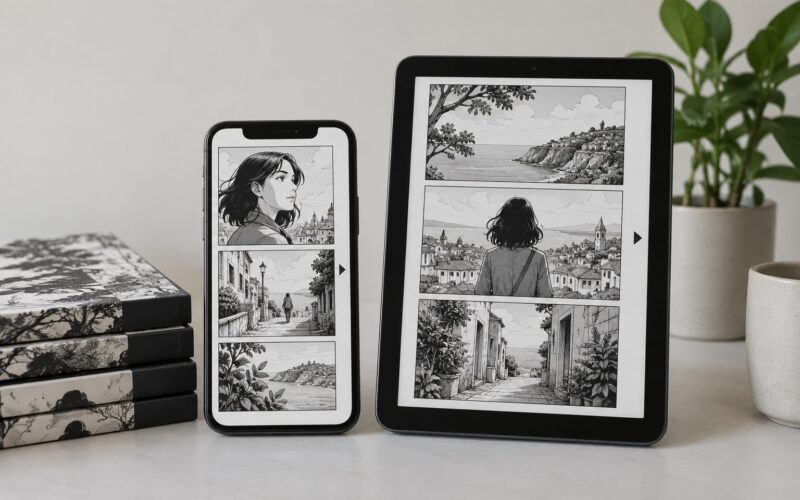
Comics also need something a novel does not: fixed-layout image pages that never reflow. A page of artwork with speech balloons and sound effects has to render exactly as drawn, at the right aspect ratio, on the right device. That requirement sits badly with reflowable text formats, and it pushed several manga services toward image-container formats rather than the mainstream ebook standard.
Add the reading experience on top. Manga apps are built around vertical scrolling, panel-by-panel tapping, offline caching of large image libraries and cloud sync of progress. Text features such as dictionaries and furigana display have almost no meaning on a comic page, so manga services skip them while text services build them out.
That is the technical reason Japan differs from book-first English-language markets. Here, the fastest-moving consumer category is comic-shaped, and the tools built for comics rarely suit novels.
Publishing Rights and Release Models Keep Catalogs Separate
Publishing rights keep catalogues separate for a plain contractual reason. Japanese publishers license digital editions to specific retailers, with terms covering territory, format, window and revenue share. There is no national law requiring a universal digital edition, so a book can appear in one store and be missing from the next.
Editions complicate it further. A hardcover, a paperback, a bunko paperback edition and a magazine serial are separate products with separate rights. When a publisher digitizes a new edition, the retailer that carries the print edition may not have any right to the new file.
Release models add another layer. Some titles appear on fixed publication dates with no preview at all. Others offer free chapters, called tameshiyomi, to drive conversion. Some ship as digital-only, some as a bundle where buying the ebook version includes a print copy. Each model has to be negotiated per retailer.
Japanese domestic distribution and English-language imports are separate channels. Foreign books enter Japan through distributors and importers with their own territorial grants, which is why an English edition of a Japanese novel and its Japanese edition may sit in entirely different catalogues on entirely different schedules.
Pricing, Formats, and Payment Systems Add Friction
Pricing, formats and payment systems add friction because each store sets its own commercial model, and readers compare prices only within a single service.
- Fixed price buys one title permanently in that store.
- Flat-rate subscription offers a set catalogue for a monthly fee, but only inside that app.
- Free chapters let you sample a series without buying, usually inside one ecosystem.
- In-app purchases often flow through the mobile platform’s billing on a phone, which ties the account to the app store on that device.
- Library access is contractual and institutional, so it rarely overlaps with consumer subscriptions.
Format and DRM follow the same pattern. Reflowable books work best in EPUB 3, image-heavy comics use CBZ-style containers or proprietary equivalents, and older Japanese hardware used XMDF. Every one of those can be encrypted so that only the original store’s app will open it.
The result is that DRM is not a single Japanese standard but a set of incompatible ones, and file format is not a neutral container but a boundary between services.
Platform Strategy, Not Reader Taste Alone, Drives the Divide
Platform strategy, not reader taste alone, drives the divide. Japanese readers did not wake up wanting six apps. Each ecosystem exists because a company made a commercial decision.
Look at the ownership map. Kadokawa runs BookWalker, and it is simultaneously one of Japan’s largest publishers and one of its largest ebook sellers, which makes it structurally reluctant to hand traffic to rivals. Dai Nippon Printing runs Honto, a company whose business is printing and distribution, so its catalog reaches it through physical channels too. Culture Convenience Club runs BookLive, and it can lean on a national store network. LINE Manga and the LINE Book Store sit inside a messaging platform that can push titles to an enormous existing user base. Rakuten Kobo and Amazon.co.jp Kindle are global operations with their own cross-border logic.
Each of these companies also wants something specific from the relationship: customer data, engagement time, membership retention, or a reason to keep a user inside its ecosystem. Sharing a catalogue with a competitor would damage the thing they are actually protecting.
Why Japanese E-book Stores Are Fragmented Compared With Other Markets
Japan’s split stands out against more consolidated markets, and it is useful to see why. In the United States, a small number of retailers account for the large majority of ebook sales, and most titles are available from more than one of them in the same EPUB file, so a purchase is a purchase everywhere.
The similarities are real, though. The US market also has regional pricing, publisher-controlled release windows and DRM on a share of titles. Fragmentation exists everywhere; it is a matter of degree and of how much of the catalogue is portable.
Japan combines two things few other large markets do at once: a comics category large enough to need its own technology, and a publishing sector large enough to sell its own ebooks. The first forces format splits, and the second keeps catalogues competitive. Neither of those is a reader preference.
What Fragmentation Means for Readers, Authors, and Marketers
For readers, the practical cost is administrative. You juggle multiple accounts and apps, availability is uneven across services, and comparing catalogs means checking several places. One useful first step is to pick the store that matches your main content type and commit to it rather than spreading your library thinly.
Users learning Japanese from abroad hit a specific set of problems. Region locks can cut off access after registering from a foreign network address, some stores expect a Japanese payment method, and mobile platforms may require switching the app store region before the reader app will even download. The first step for a learner is to check access requirements before buying anything.
For authors and self-publishers, distribution is per-store work. Metadata has to be prepared for each platform, formats and rights are granted separately, and payouts arrive from each retailer separately. There is no single export that puts a title everywhere at once.
For marketers, a publisher partnership is a channel decision rather than a distribution decision, and a store often controls the promotion of titles it carries. The first step is to decide which ecosystem you are building for, based on content type, before signing rights deals.
One more risk deserves naming. Buyers reasonably worry about what happens to a library if a service closes. ebookjapan, once a major store, shut down, and its catalogue did not survive as a single destination for existing customers. That history is the reason library portability is a fair question to ask of any Japanese store.
Frequently Asked Questions
Is there one dominant ebook store in Japan?
No. Japan has roughly a dozen significant ebook stores run by rival corporate groups, including BookWalker (Kadokawa), Honto (Dai Nippon Printing), BookLive (Culture Convenience Club), LINE Manga and the Kindle Store on Amazon.co.jp. None of them carries every title, so a reader wanting full coverage still needs more than one. That is the practical meaning of a fragmented market.
Why are manga and comics sold through separate Japanese apps?
Comics are published as fixed-layout image pages rather than reflowable text, so they need different rendering, scrolling and caching than novels. Manga services build for panel-by-panel vertical reading and large image libraries, and text features like dictionaries or furigana display are meaningless on artwork. Separate apps result from separate technical requirements, not from a different audience.
Can you transfer a purchased ebook from one Japanese store to another?
In almost all cases, no. Purchases are licensed to one retailer, delivered in that retailer’s format and encrypted with that retailer’s DRM, so another store’s app cannot open the file. There is no universal export in the Japanese market. If keeping your library portable matters to you, check a store’s terms before committing, and download backups where the app allows it.
Why are some Japanese books available in print but not as ebooks?
Digital rights are licensed separately from print rights, and often per retailer. A publisher may hold rights to a hardcover edition without holding rights to a digital edition, or may license the digital file to one partner only. Japanese readers are therefore used to titles that exist in bookshops and nowhere online, which is unusual in more consolidated markets.
What should foreign publishers consider when selling ebooks in Japan?
Plan for a per-store distribution model rather than a single launch. Territorial rights, metadata standards, file formats and vertical text rendering all need preparing per retailer, and each platform sets its own terms and reporting. Decide which content type you are selling, since comics and text follow different technical paths, and confirm who handles Japanese-language support before signing.
Conclusion
The fragmented Japanese ebook stores are not an accident of reader taste or a lack of good technology. They are the sum of per-store publishing licences, incompatible formats and DRM schemes, comics-driven technical requirements, device bundling decisions from the 2000s, and corporations that each chose to run their own channel.
It is easing at the edges. Later entrants built cloud libraries rather than bundled hardware, and at least one long-running store has already shut down, which pushes remaining services toward larger catalogues.
Start by identifying three things: the device you read on, the type of content you actually want, and the publisher ecosystem it sits in. Choose one store, learn its rules, and treat the others as specialists you visit rather than a library you maintain.