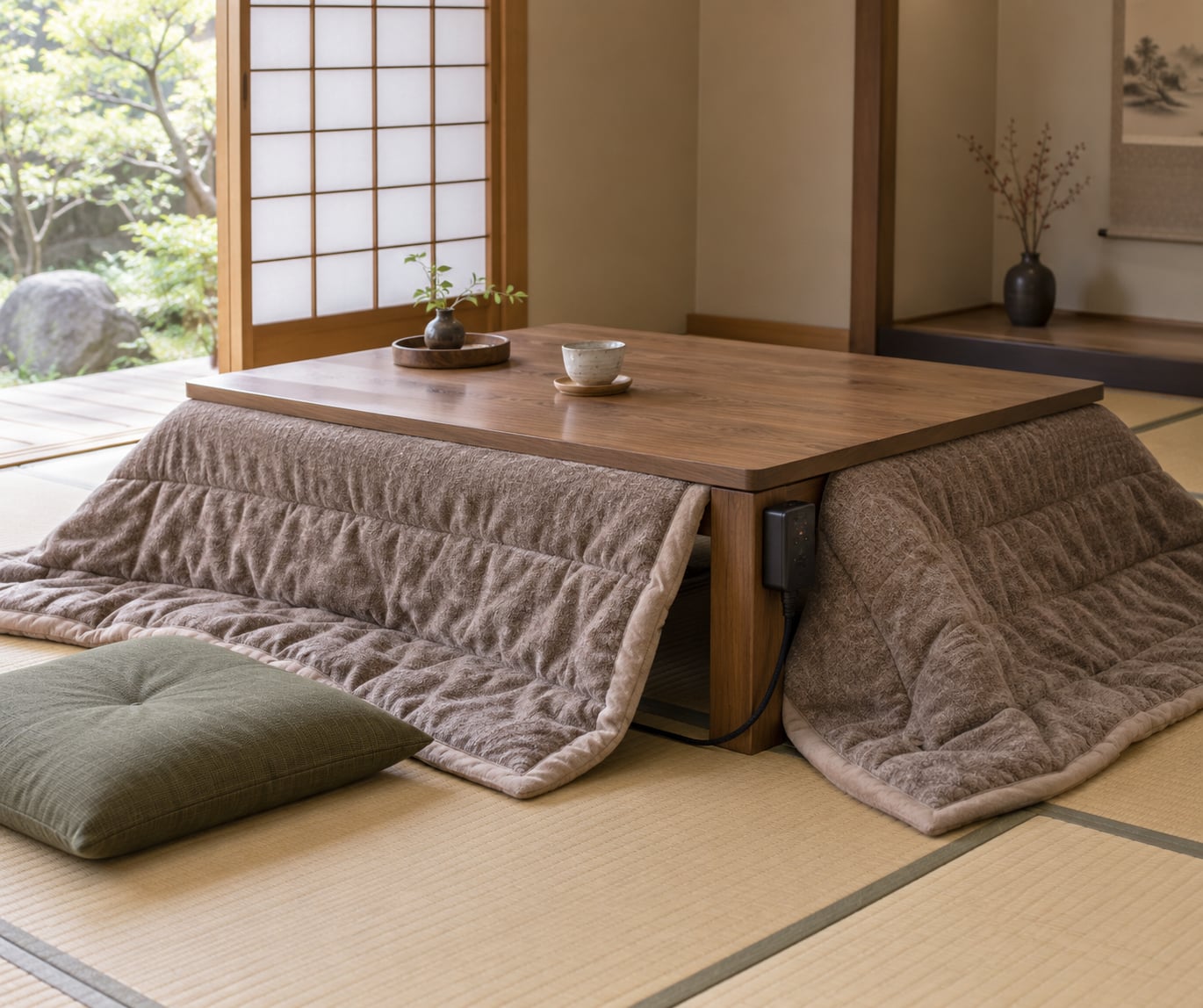
A Japanese heated table is called a kotatsu: a low wooden frame, usually 35 to 40 cm off the floor, with an electric heating element fixed to the underside of the tabletop and a heavy quilted blanket thrown over the whole thing so its hem reaches the floor. Understanding how Japanese heated tables work comes down to three parts working together, and once you can see them you will not confuse a kotatsu with an electric blanket again.
That distinction matters more than it sounds. A kotatsu does not warm a room. It warms the pocket of air under a blanket, roughly the size of a large suitcase, and that is enough to change how a person feels about a cold afternoon.
Table of Contents
- 1What Is a Japanese Heated Table?
- 2How Japanese Heated Tables Work
- 3The three layers of a kotatsu
- 4Why the physics works
- 5What Are the Main Heating Systems?
- 6How Does the Heat Reach the Room?
- 7How Do Temperature Controls Work?
- 8What Should You Look for When Choosing One?
- 9Are Japanese Heated Tables Safe?
- 10How Do You Use One Efficiently?
- 11Frequently Asked Questions
- 12Are Japanese heated tables the same as kotatsu?
- 13Do Japanese heated tables heat the whole room?
- 14How much electricity does a Japanese heated table use?
- 15Can a heated table be used on carpet or tatami?
- 16How warm should a heated table be set for everyday use?
- 17Can you repair or replace a heated table’s heating element yourself?
What Is a Japanese Heated Table?
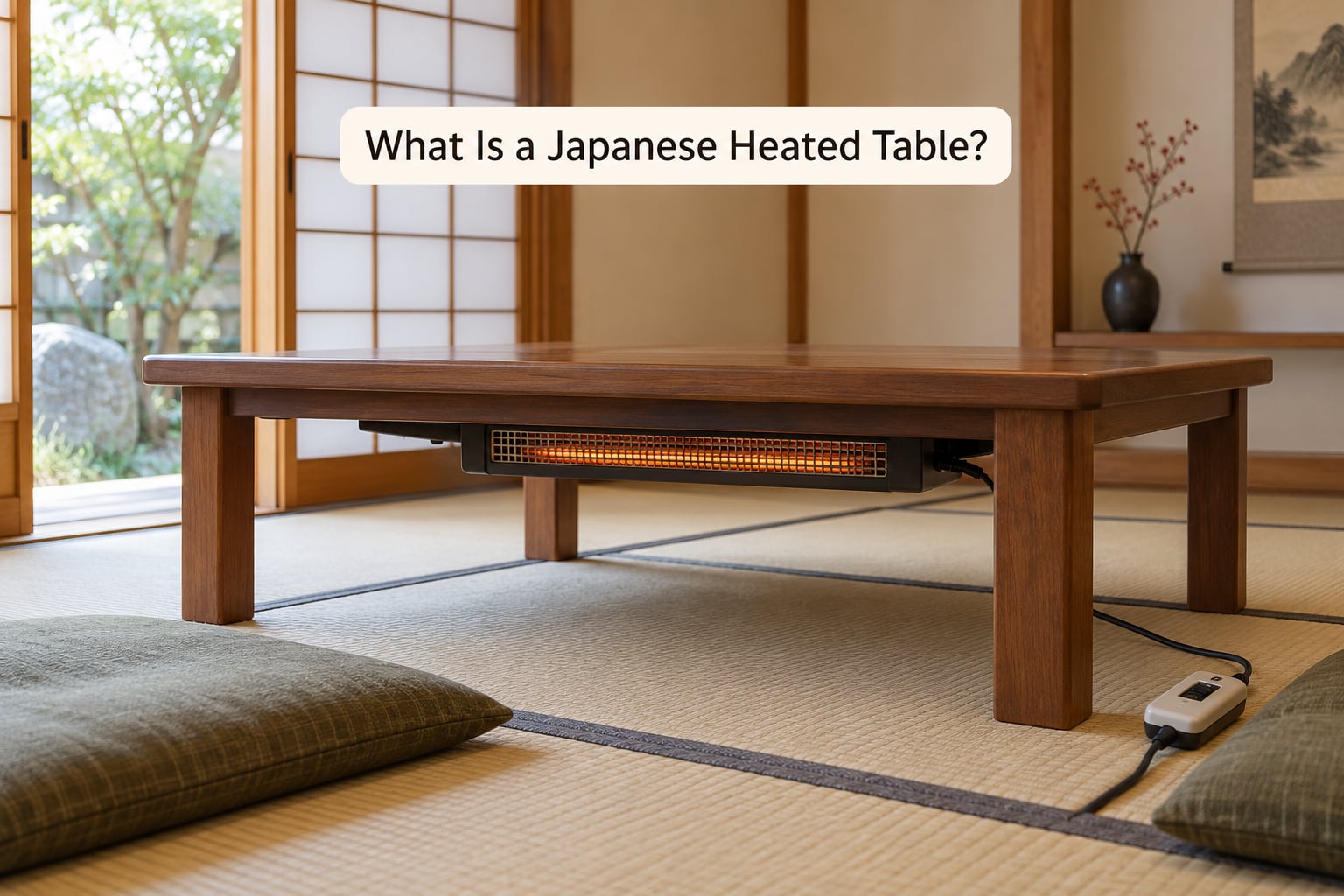
The short definition: a kotatsu is a low table with an electric heater under its top, a blanket over its frame, and floor cushions to sit on. In Japan it usually sits on tatami in the main room of the house and becomes the centre of the household for a few months of the year.
Plain low tables are called chabudai, and they are the same piece of furniture minus the heater. You sit on a zabuton cushion and pull the blanket over your legs, so the table itself is not really something you sit at. You sit around it, with your legs under the quilt.
It is easy to lump kotatsu in with other electric comforts, so here is where the line sits:
- Electric blanket: heats your body directly and covers only you. A kotatsu heats a shared volume of air and warms everyone under the quilt.
- Space heater: pushes warm air into an open room, where most of it rises to the ceiling. A kotatsu traps its heat under a lid.
- Underfloor heating: heats the floor of a whole room from a construction layer. A kotatsu is a single freestanding unit you can move.
- Radiator or heat pump: heats air or water for the whole building. A kotatsu is a seasonal, single-room comfort.
Two heights dominate. The classic floor-seated kotatsu stands about 35 to 40 cm high and puts everyone at floor level around it. The coffee-table version stands closer to 45 to 55 cm and takes a chair or a stool, which is why it shows up in small apartments and in families with older members.
Its ancestor is the irori, a sunken hearth cut into the floor with a charcoal fire in the middle and people seated around the hole. The kotatsu is that idea moved above ground and, since the postwar period, powered by electricity.
How Japanese Heated Tables Work
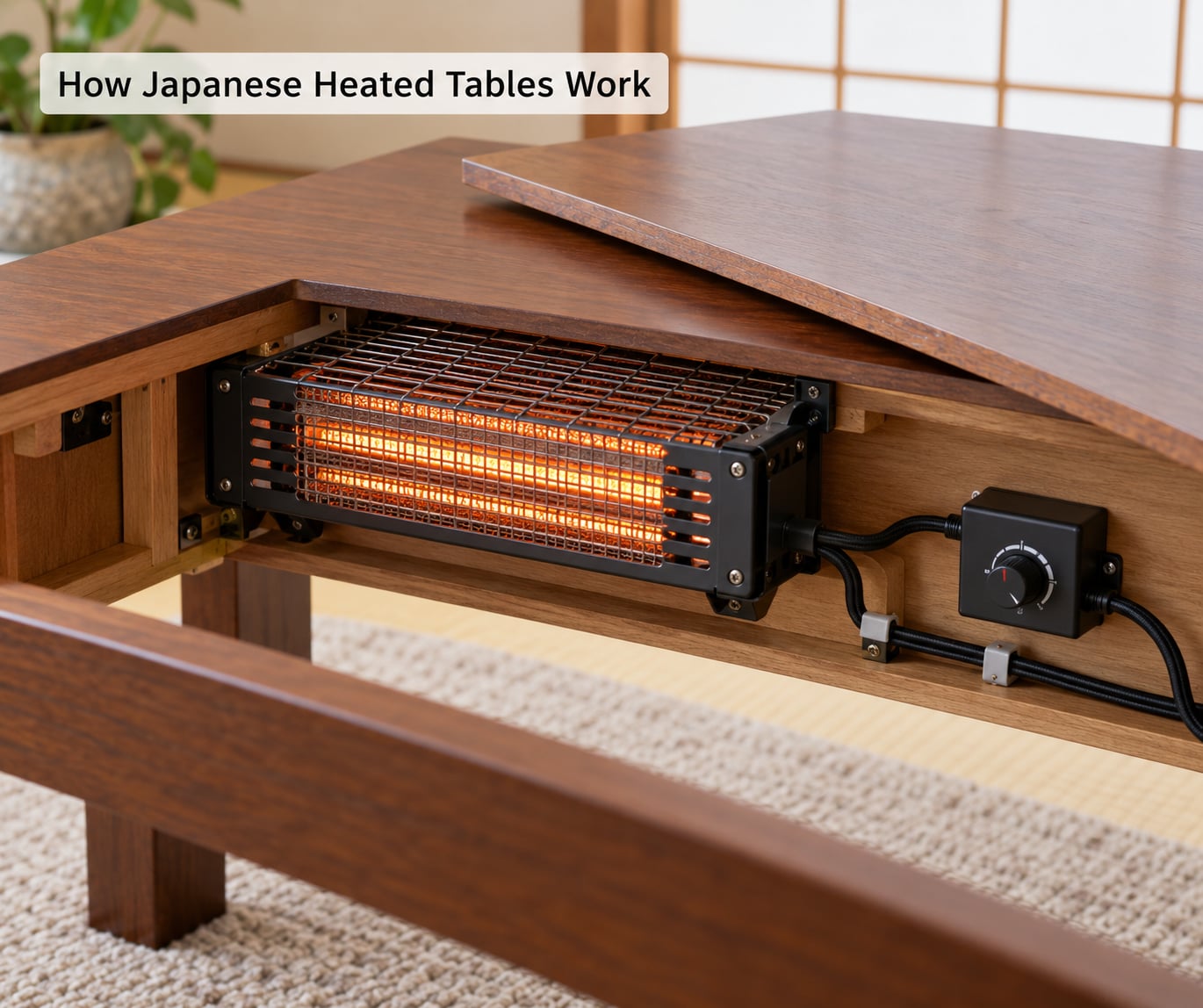
Electricity runs to a resistive element mounted under the tabletop. The element gets hot, warms the tabletop by conduction, and the tabletop radiates and convects heat downward into the space beneath it. The blanket drops over the frame and seals that space, so warm air rises to the lid instead of escaping across the room. A thermostat and power switch on the leg of the frame let you set how hard it runs.
The three layers of a kotatsu
- The heater. A flat element, usually between 200 and 600 W, screwed or clipped beneath the top panel. On older models it hangs in a metal frame on the table legs; on newer ones it sits inside the tabletop itself.
- The blanket. A quilted futon, typically around 190 by 240 cm with a metre or two of cotton fill, draped over the table so it falls to the floor on all sides. The blanket is not decoration. It is the lid that stops the heat escaping, and owners consistently describe it as the part that makes the whole arrangement work.
- The tabletop. The board that closes the pocket from above. It conducts heat down into the blanket and takes a wear mark or scorch ring over the years; many people put a removable panel or a heat-resistant mat over it.
Why the physics works
People familiar with kotatsu report air under the blanket settling somewhere around 25 to 35°C, reached in about 5 to 15 minutes depending on the model and the starting temperature. That sounds mild on a thermometer, but it is measured in a sealed space with no drafts and no moving air, which is exactly the condition a body finds comfortable.
Heated volume is the part almost nobody explains. The space under a blanket is well under one cubic metre. A 1500 W fan heater has to push air through an entire room, replacing the volume many times an hour and losing most of that heat to the ceiling and walls. A 500 W element is heating a box the size of a suitcase, so nearly all of its output stays in contact with people. The physics is simple and the number is lopsided.
Feet do not need to be under the table itself. Owners say being under the tent of the blanket is enough, which is why the blanket hem reaching the floor matters more than the size of the element.
What Are the Main Heating Systems?
Most Japanese models are electric, and the differences come down to the element. Traditional charcoal versions still exist, and imported antique hibachi braziers turn up in video results for a reason: they are the version people find visually, not the practical one.
| System | Typical output | How it heats | Watch for |
|---|---|---|---|
| Carbon fibre element | 200-600 W | Even radiant warmth across the whole panel, slow to warm | Most common type today; broad, gentle heat |
| Halogen lamp heater | Around 300 W | A glowing lamp radiates downward, warms fast | Hotter to the touch, more directional |
| PTC ceramic heater | 200-400 W | Ceramic element that self-limits temperature | Runs cooler and flatter; common in small tables |
| Charcoal brazier (hibachi, irori) | Fuel, not watts | Burns fuel in a pot sunk into a pit or frame | Ventilation, ash, burns; now mostly display pieces |
| Floor-embedded warmers | Varies | Heating mat or cable installed under flooring | Fixed installation, not a portable kotatsu |
Two traditional layouts still turn up in the vocabulary. The hori-gotatsu is a kotatsu dug into the floor, a pit about 40 cm deep with the heater below floor level and the table top level with the tatami. The oki-gotatsu is the placed version that stands on the floor like a normal table. Almost everything bought today is an oki-gotatsu.
How Does the Heat Reach the Room?
In three stages, and none of them is “warming the room”. First, conduction carries heat from the element into the tabletop. Then convection circulates that heat in the trapped air under the blanket, where it rises to the lid and comes back down. Finally, radiation warms your legs, hands and face directly, which is the part your body actually notices.
Put differently: the tabletop conducts, the sealed pocket convects, and your skin receives by radiation. A thin blanket over your legs means radiation does most of the work, and a thick quilt does more of it because the trapped air layer is thicker.
What escapes into the room is real but modest. Warm air does eventually leak out from under the hem, and in a sealed room you will feel the far wall slowly lose its chill. People still say the rest of the house stays cold, which is why the usual practice is to run the kotatsu in the room you are actually sitting in and keep the doors shut.
The comparison people search for is with a space heater. A 1500 W space heater heats air everywhere, including the empty top two metres of the room. A 500 W kotatsu heats the only volume that has people in it. For comfort per watt, the table wins, and this is the single clearest answer to whether a kotatsu counts as real heating. It does, just not the kind that dries out the air on the ceiling.
How Do Temperature Controls Work?
Most kotatsu use a simple control mounted on the table leg or on a remote pendant: a power level switch, often three or four steps, plus a thermostat or timer dial. Turning it up increases the current through the element, which raises the temperature it settles at. Turning it down does the opposite, which is the control most owners actually use day to day.
Deeper models add a digital panel with a target temperature, an on-screen countdown, and a weekly timer, so you can program warmth for the evening and have it shut off overnight. A few accept a remote or an app, which matters if you want to warm the room before you walk in from the cold.
Every heated table should also have a thermal cutoff: a sensor that cuts power if the element or frame overheats, usually because the blanket is folded up over the vent or the unit is blocked. If yours lacks one, treat that as a reason to look at a different model.
Control features vary widely by model and manufacturer, so read the manual rather than assuming a dial does what a digital panel does. The manual also tells you how long the manufacturer expects you to leave a setting running unattended, which is the number to look up before you go to bed.
What Should You Look for When Choosing One?
Start with the room and the people, not the wattage. A floor-seated 35 to 40 cm kotatsu suits a tatami room and cushions on the floor. A 45 to 55 cm coffee-table height works with normal chairs and makes more sense in a small apartment or a home with people who do not kneel. The right choice is about the height that matches how your household already sits.
Then check these things:
- Heated area against blanket size. A bigger element than the blanket can cover just heats the middle. A blanket of roughly 190 by 240 cm is the common baseline for a square kotatsu.
- Frame construction. Solid wood holds up better around heat and humidity. Particle board is common and lighter, but it is the part most likely to warp over seasons.
- Top weight and texture. A heavy or textured top keeps the blanket from sliding off. That question comes up constantly in DIY threads, and the answer is more mass under the quilt, not more heat.
- Thermostat and cutoff. A proper thermostat plus a thermal cutoff is worth paying for.
- Portability. Removable tops and a frame on casters make the difference between a seasonal fixture and something you move out of the way in April.
- Floor compatibility. On tatami it is fine. On carpet, check the manual, because airflow and heat build-up under the unit differ.
- Noise and warranty. Elements are quiet; a faint hum from the thermostat relay is normal. Warranty length varies, and spare elements are worth checking for before you buy.
If you are buying outside Japan, add the supply question. Japanese kotatsu are built for 100 V mains, and a typical unit draws 300 to 500 W. On a 230 V supply you need a proper step-down transformer rated for the unit’s draw with headroom, not a travel converter. Owners warn specifically about cheap converters for this reason: at 300 to 500 W they run hot, and the failure happens while a blanket is over the top. Check the unit’s rated voltage and wattage on its label first, and use the manufacturer’s guidance.
Are Japanese Heated Tables Safe?
They are, and the mechanism is simple: a low-wattage element sealed inside a table, covered by a blanket, with a thermostat and a thermal cutoff between it and the room. The risks that do exist are practical ones you can manage.
- Grounding and cord condition. Use the manufacturer’s plug into a grounded outlet, and stop using the unit if the cord, plug or socket is damaged or runs hot.
- Clearance. Keep the heater away from curtains, bedding piles and furniture, and never fold the blanket over the element vents or the frame in a way that blocks them.
- Burns. The tabletop and frame reach temperatures that will sting bare skin. Children and pets are the ones to watch; keep a low table out of a crawling baby’s path if it runs hot enough to burn.
- Overnight sleeping. Naps under a kotatsu are common and generally fine. Sleeping there all night is where the real caution sits: most adults are not fully covered, so heating is uneven, and a heavy quilt over a sleeping body raises the risk of overheating and dehydration. If you want warmth through the night, heat the room instead.
- Follow the manual. Instructions on maximum run time, minimum clearance, allowed floor surfaces and what must not be draped over the heater come from the manufacturer and should be the last word, not an article.
- Electrical work. Never rewire a table heater or swap in a different element yourself. Have a qualified electrician handle anything involving mains wiring.
One habit worth copying from Japan: in spring the family washes the futon, dries it in the sun and stores the table. A heated table is a seasonal object, and treating it that way keeps both the blanket and the wiring in good condition for the next winter.
How Do You Use One Efficiently?
The efficiency case is already made by the physics: a few hundred watts warming a sealed pocket beats a fan heater pushing air around an empty room. A few habits stretch that further.
- Preheat for 10 to 15 minutes. Turn it on while you are making tea or before guests arrive, then sit down. Warming an empty table is the one step that is pure loss.
- Start at the lowest level that feels warm. Most households settle on the second setting up and never go higher.
- Use the timer. Program warmth for the evening and a shut-off for the night rather than running a fixed dial setting indefinitely.
- Close the curtains and doors. Less air movement means the pocket holds its temperature, and it keeps the rest of the house from chilling.
- Clear the area under and around the table. Nothing stored against the element, and a clear path so nothing knocks it.
- Switch it off when the room empties. The single largest saving available, and the one most households skip.
For anyone tempted to build one at home from a low table and a foot-warmer pad, that approach appears often in community threads and it can work, but the safety questions in those threads are not really settled. Match the pad’s wattage to the clearance, keep the element fully covered by the blanket, and follow the pad’s own instructions.
Frequently Asked Questions
Are Japanese heated tables the same as kotatsu?
Yes. A Japanese heated table is a kotatsu. The word covers both the classic floor-seated table, about 35 to 40 cm high with a heater under the top, and the taller coffee-table version at 45 to 55 cm. People also say kotatsu for the whole arrangement, meaning the table plus its blanket and the floor cushions around it.
Do Japanese heated tables heat the whole room?
Not really, and that is the design rather than a flaw. A kotatsu heats a sealed pocket under a blanket that is under one cubic metre, reaching roughly 25 to 35 C. Some warmth leaks out and will take the edge off a closed room, but it is a local comfort. If you want a room warm end to end, you need room heating.
How much electricity does a Japanese heated table use?
Most electric kotatsu draw between 200 and 600 W, with 300 to 500 W the usual range on a standard unit. Running a 500 W element for an hour uses about 0.5 kWh. That is roughly a third of what a 1500 W fan heater pulls, and because the heat stays trapped under the blanket, almost all of it reaches the people sitting there.
Can a heated table be used on carpet or tatami?
Tatami is the normal surface and every kotatsu is designed for it. Carpet works in many homes, but read the manual first, because airflow under the unit and heat build-up differ from a hard floor. Keep the heater clear of floor coverings that could block its vents, and never drape the blanket over the element itself.
How warm should a heated table be set for everyday use?
Start at the lowest level that feels comfortably warm under the blanket and stay there for daily use. Owners report air under the quilt at roughly 25 to 35 C, which sounds cool but reads as warm because it is still air in a sealed space. A short higher setting for a nap is fine; a permanently high setting is neither efficient nor comfortable.
Can you repair or replace a heated table’s heating element yourself?
No. The element is a mains component fixed to the frame or tabletop, and replacing it involves opening the wiring. Take a failed heater to a qualified electrician or contact the manufacturer, and stop using the table until it is looked at. Changing the cord or plug yourself falls into the same category of mains work.
If you want to try one, start with the room you sit in most and a blanket that reaches the floor on all sides. That single detail is what turns a heater into a kotatsu, and it costs nothing extra.