Japanese toilets became high tech because three things lined up: a dense postwar sewerage system, an unusually small average bathroom, and a consumer-electronics industry that knew how to shrink motors, sensors and control boards until they fit behind a toilet lid. TOTO put the pieces together in its 1980 Washlet, and the rest of the industry followed. Everything after that — heated seats, warm-water sprays, dryers, deodorizers, auto-flush, occupancy sensors, app control and health monitoring — is one long refinement of that same idea.
Most people notice the flush first. The birdsong you hear in a Japanese public restroom is not a speaker playing a forest recording for ambience; it is deliberate sound masking, added because loud flushing in a next-door cubicle was socially unbearable. That one detail tells you a lot about how this technology evolved. Every feature was solving a specific, slightly embarrassing Japanese problem.
Table of Contents
- 1How Japanese Toilets Became High Tech
- 2The milestone years that shaped the modern toilet
- 3What Counts as a High-Tech Toilet?
- 4The Engineering Behind the Features
- 5Sensors
- 6The water path
- 7Motion
- 8Air
- 9Control board and panel
- 10Water and flushing
- 11What Helped Drive the Innovation?
- 12From Electronic Bidet to Smart Toilet
- 13What Is the Japanese Washlet?
- 14How Does a High-Tech Toilet Work?
- 15Why Are These Features Useful in Japan?
- 16What Should Buyers Look For?
- 17Check the installation constraints first
- 18Decide what you will actually use
- 19Look at the control layout honestly
- 20Judge water and energy use
- 21Check noise, then check support
- 22Do not pay for connectivity you will ignore
- 23What Limitations Should Readers Know?
- 24Frequently Asked Questions
- 25Why are Japanese toilets so high tech?
- 26When did TOTO release the first Washlet?
- 27How do you use a Japanese toilet?
- 28Why don’t Americans use bidets?
- 29What are the disadvantages of Japanese smart toilets?
- 30Are Japanese toilets hygienic?
- 31Conclusion
How Japanese Toilets Became High Tech
The short answer is plumbing history plus consumer electronics plus a housing market with no room to spare. Japan’s postwar rebuild pushed treated sewerage into cities that had largely used pit toilets and night soil collection, and the same rebuild produced a manufacturing sector very good at making small, reliable, mass-produced electronics.
Plumbing gave Japan a flush toilet to build on. Housing gave it a hard constraint: a typical apartment bathroom is roughly the size of a standing person plus a door swing, so anything that worked had to work in a shallow footprint behind a wall panel. Electronics gave it the means to add comfort and automation without needing more space. That combination is the whole story of how japanese toilets became high tech.
The milestone years that shaped the modern toilet
| Year | What happened | Why it mattered |
|---|---|---|
| 1904 | Nippon Toki (a Morimura Group company) begins producing sanitary ceramics | Japan gains a domestic porcelain industry instead of importing every fixture |
| 1914 | Japan’s first domestic sit-down flushing toilet is developed | The squat washiki toilet stops being the only option |
| 1917 | Toyo Toki is founded in Kitakyushu | The company that becomes TOTO starts making toilets |
| 1923 | The Great Kanto Earthquake destroys Tokyo and Yokohama | Rebuilding forces sewerage expansion and a jump in demand for sanitary ware |
| 1938 | Modern fixtures installed in the Dai-Ichi Seimei Building | Japanese commercial buildings show off Western-style bathrooms |
| 1946 | TOTO begins making its own faucets | Vertical integration into brass and valve parts |
| 1964 | Tokyo Olympics | Foreign visitors see Japanese bathrooms, and the unit bathroom spreads in new housing |
| 1969 | Toyo Toki shortens its name to TOTO | A compact brand for an export push |
| 1977 | Sit-down toilets outsell squat toilets | The washiki loses its majority hold on new homes |
| 1980 | The first-generation Washlet launches | A heated seat with a warm-water spray becomes a consumer product |
| 1982 | Oshiri datte, aratte hoshii (“tidy up, and wash it”) commercial airs | Washing replaces wiping as the mainstream habit in advertising |
| 1980s–1990s | Self-cleaning nozzles, oscillating spray, ozone deodorization | The bidet stops being a novelty and becomes plumbing-standard |
| 2000s | Export push accelerates; overseas sales roughly double from a 100 billion yen base | Washlet designs start appearing in hotels and homes outside Japan |
| 2020s | Stool-analysis and health-monitoring toilets reach the market | The toilet is re-framed as a health sensor, not just a fixture |
Two more numbers put the scale in perspective. Government survey work has put bidet-equipped households at well over 80% of Japanese homes, and industry association figures put warm-water bidet seat sales in Japan past 100 million units by the early 2020s. TOTO claims roughly 60 million Washlets sold worldwide. For a device most people only notice when it is missing, that is an extraordinary reach.
What Counts as a High-Tech Toilet?
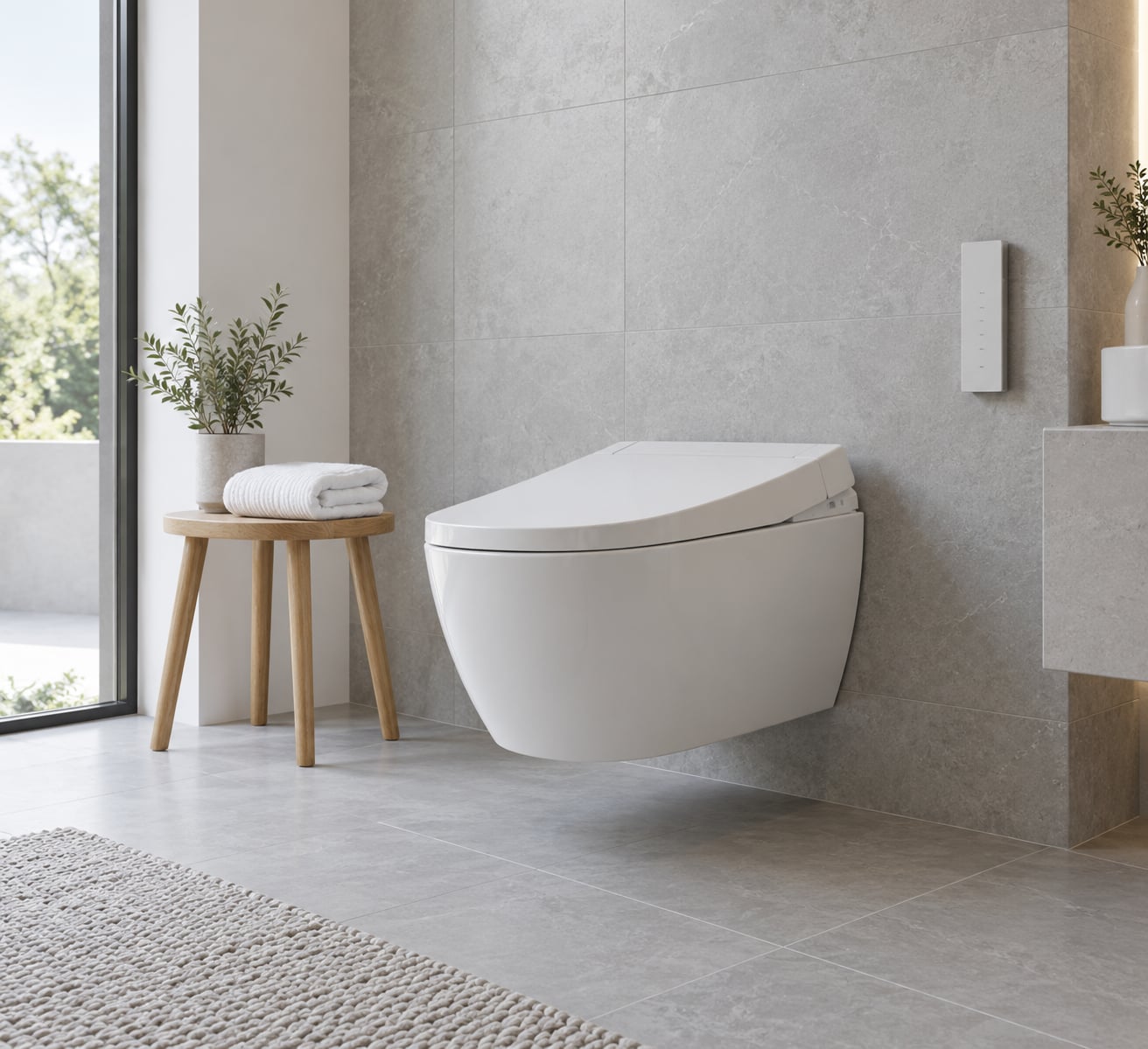
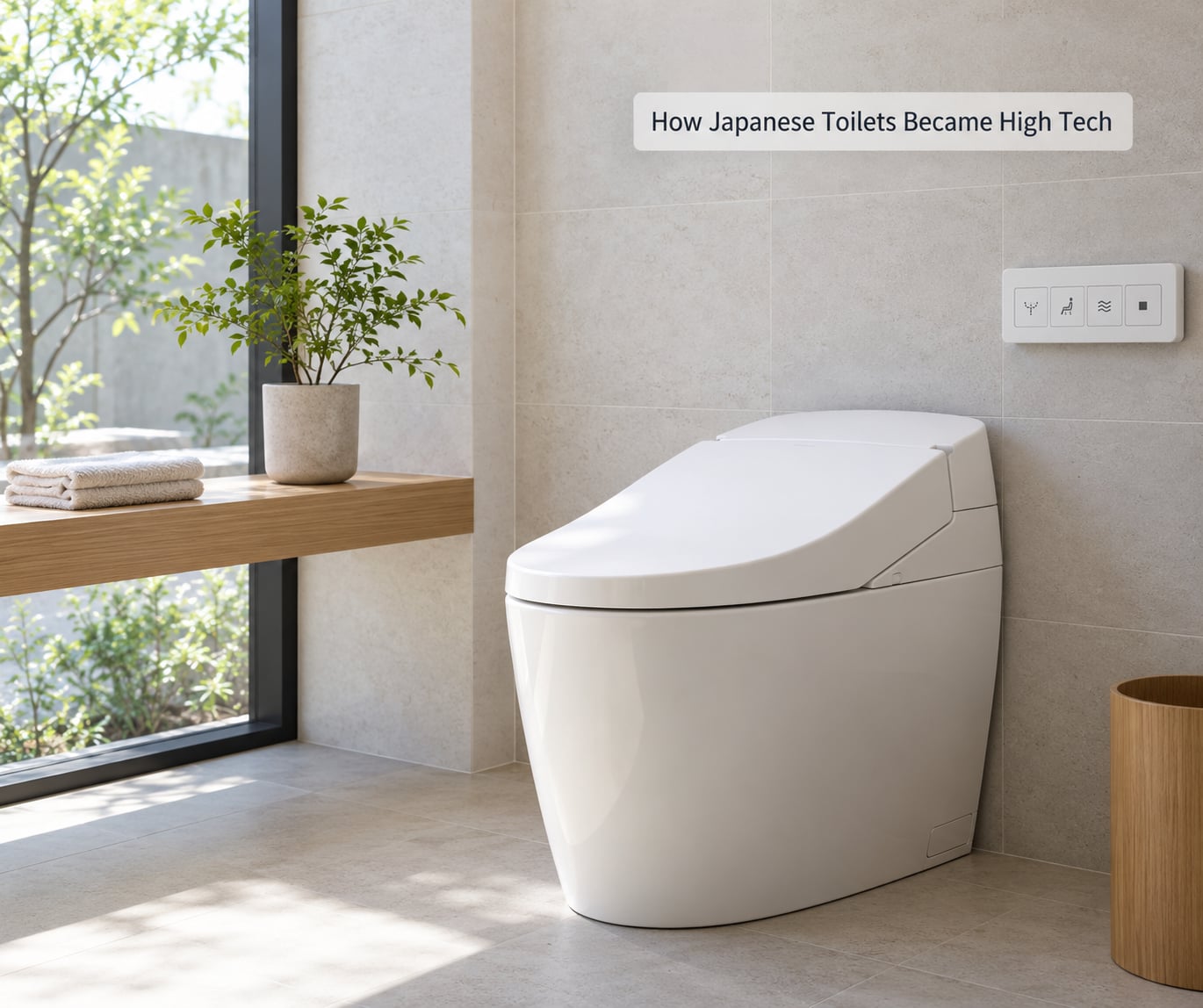
A high-tech toilet is a floor-mounted ceramic bowl with an integrated electric seat that senses you, warms itself, sprays warm water at an adjustable pressure, dries you, deodorizes the bowl and flushes itself. That is the definition, and it is worth stating plainly because plenty of sold “smart” toilets in other countries are ordinary bowls with a plastic attachment.
The features you will find on a genuine integrated model:
- Heated seat with adjustable temperature levels
- Warm-water rear wash, usually with pressure, position and temperature control
- Optional front wash
- Warm-air dryer instead of, or alongside, paper
- Deodorizer, often using an ozone generator or a deodorizing filter
- Automatic flush triggered by the seat sensor
- Sensor-activated lid that lifts when you approach and drops when you walk away
- Seat occupancy sensor that gates most buttons
- Concealed cistern, so there is no visible tank or pipework
- Night light, soft-close lid, and on premium models a remote panel or app
Against a standard Western toilet, the difference is one of degree and integration. A Western bowl has a flush handle. A Japanese unit has a flush function, a wash function, a dry function, a deodorize function and an occupancy function, all running off one circuit behind a panel.
The Engineering Behind the Features
Everything in a Washlet is plumbing and low-voltage electronics sharing a very shallow box. Break it into six parts and the complexity drops away.
Sensors
A microwave or infrared occupancy sensor in the bowl detects a user. A seat pressure sensor confirms somebody is actually sitting, which is what stops the flush from firing on an empty bowl. A distance sensor in the lid detects approach and departure. Those three signals drive almost every automated behaviour.
The water path
A small storage tank and an electric heating element keep water warm inside the seat housing, so the spray arrives hot rather than at ambient pipe temperature. A pump drives water through a dedicated nozzle, and a control valve modulates pressure on the way out. Add a thermistor on the water line and the loop can hold a chosen temperature instead of oscillating between cold and too hot.
Motion
A stepper motor extends, retracts and sweeps the nozzle. That single mechanism gives you nozzle position adjustment, oscillation across the rear, and a narrower or wider spray pattern — all from one moving part.
Air
A second, smaller blower pushes warmed air through a nozzle near the seat rim for drying, and in deodorizing models a fan moves air across the bowl surface or through a filter bed.
Control board and panel
A microcontroller reads the sensors, drives the valves, motor and heater, and enforces the safety logic. The wall panel or handheld remote is just a keypad wired to it, usually on a low-voltage bus so one thin cable replaces a bundle of switch wires.
Water and flushing
The flush itself is a separate low-flow system. A concealed cistern feeds a rim-and-jet flush pattern that clears the bowl with a fraction of the water an older 9-litre tank used; current models are commonly quoted at around 3.8 litres per flush, with some certified low-flow units below that.
One of the stranger engineering consequences is sound. Noise masking exists because the flush is quiet but not silent, and because an audible flush was a public embarrassment. A stored sound effect played at the moment of flushing covers the mechanical noise. Visitors remember the birds. It is a noise-control feature, not a spa.
What Helped Drive the Innovation?
Seven forces did most of the pushing, and it is worth naming them because “Japan is futuristic” explains none of them.
Compact urban homes. Japanese apartments are small, so the toilet absorbed the functionality other bathrooms might spread across a sink and a separate fixture. A wall-hung bowl with a concealed cistern and a panel gives maximum function in minimum floor area.
Attention to cleanliness. Washing with warm water instead of dry paper suits a culture where daily bathing, fresh bedding and visible cleanliness carry real weight. The bidet fits that, rather than fighting it.
Four distinct seasons. A tiled bathroom in a Hokkaido winter is genuinely cold. The heated seat was not a luxury add-on; it was the feature that made an unheated room usable at 7am in February.
An ageing population and post-surgical care. A warm spray helps users with limited mobility, and hospitals adopted electronic bidet seats for post-partum and post-operative patients long before homes treated them as standard.
Hospitality expectations. Ryokan, business hotels and capsule hotels all put electronic bidet seats in rooms as a matter of course. Inbound tourism turned the feature into something visitors meet in the first hour of a trip, which did more for the global image than any advertisement.
Water scarcity and sewer load. Reduced flush volume mattered in dense cities, and pressure-compensating flush design let a low tank work well without siphoning everything in the building.
A strong consumer-electronics industry. Japan already had the motor, sensor, display and small-controller supply chain. A smart toilet is a consumer-electronics device that happens to be plumbed in, and the industry knew how to build it cheaply.
From Electronic Bidet to Smart Toilet
The development path is easier to follow as a series of problems being solved, one after another.
Step one: heat. The earliest electronic seats solved cold. A resistance heater under the seat with a thermostat was the whole product for a while.
Step two: wash. A warm spray needed a tank, a pump and a valve — and that is where the real engineering went. Pressure control and temperature control separated a useful device from an unpleasant one.
Step three: dry. Once you have warm air in a toilet, paper largely stops being necessary. Long-term users consistently say the dryer, not the wash, is the feature that removes paper from the routine.
Step four: deodorize. Odour control moved from an air freshener in the room to treatment at the source: fan-assisted deodorizing filters and ozone generators that break down odour molecules in the bowl.
Step five: automate. Occupancy sensors let the unit do the boring things — lift the lid as you approach, drop it after, flush when you stand up, run a nozzle rinse. The toilet starts behaving like an appliance rather than furniture.
Step six: maintain itself. Self-cleaning nozzles, pre-rinse cycles and nozzle-drying functions address the one legitimate hygiene objection to a spray toilet.
Step seven: connect. Premium units add remotes, wall panels, night lighting, ambient sound, and on some models voice assistants and apps. This is where the category is being pushed now, and where I would be most careful about what actually earns its place.
Step eight: measure. The newest development, reported in the Japanese news wire in early 2026, is toilets that analyse stool in the bowl and flag health indicators. Japanese makers are framing the toilet as a passive health monitor that checks in while nobody is thinking about it. Whether that becomes a mainstream feature or an expensive niche is genuinely open.
There is a second Japanese technology story running alongside the toilets. TOTO and its competitors supply advanced ceramics and precision components to semiconductor and hardware manufacturers, so the same industrial base that fires the ceramic also mills the parts of the machines that make computer chips. The toilet is the visible end of a much deeper manufacturing story.
What Is the Japanese Washlet?
Washlet is TOTO’s registered trademark for its electronic bidet seat, and in practice the word has become a category term the way “hoover” did for vacuum cleaners. Japanese and English-language readers use it to mean any warm-water bidet seat, sometimes including retrofit models that clamp onto an existing Western bowl.
It is worth being clear about what the name does not promise. Washlet is a brand, not a specification. Two products sold under the same word can differ by twenty years of engineering, and the most basic seat bearing that name may do one warm spray and nothing else — no dryer, no deodorizer, no sensor lid. TOTO also uses it across a wide price band, from simple retrofit seats to fully integrated floor-mounted units with concealed tanks.
The word comes from reversing a phrase into a name, the same way a brand wants it to read. It carries no more technical information than “bidet seat” would.
How Does a High-Tech Toilet Work?
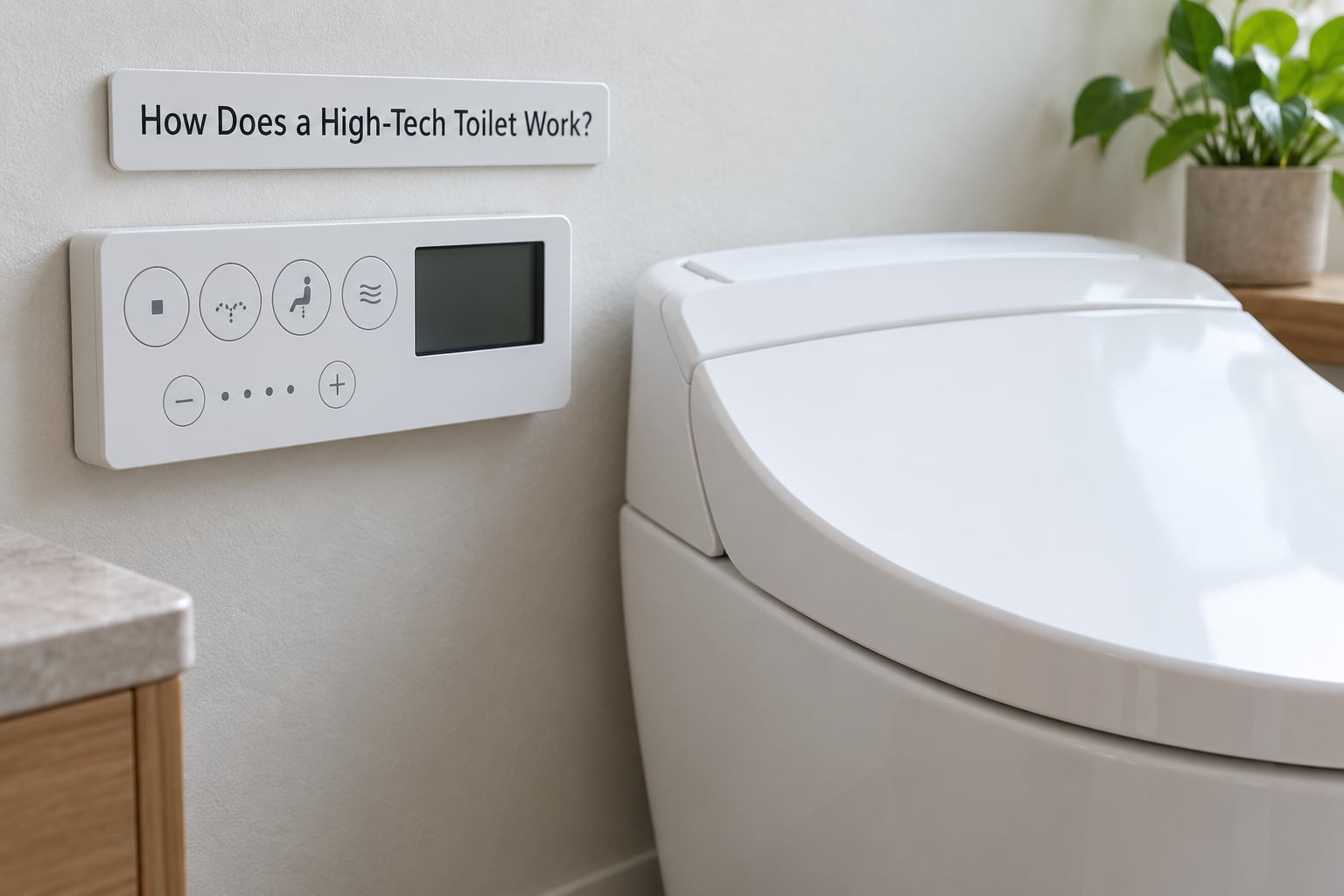
One complete cycle, from walking in to walking out, looks like this.
1. Approach. The lid sensor detects you at roughly a metre or two and raises the lid and seat, if the auto-open setting is on.
2. Sit. The pressure sensor under the seat registers weight and marks the seat occupied. Until it does, most wash and dry buttons are deliberately inert — this is the single most common source of confusion for first-time users, who press a button and get nothing back.
3. Choose a wash. The panel’s rear button starts water at the stored temperature. Pressure, spray position and nozzle width are adjustable on most models, and a long-press or second button shifts to a front wash if the unit has one.
4. Stop. Pressing the stop button halts water and retracts the nozzle. An anti-drip dry pass runs the nozzle and pumps the remaining water out of the nozzle path.
5. Dry. The warm-air dryer runs for as long as you let it. Users who say they have gone paperless usually mean they dry fully, not partially.
6. Stand and go. The pressure sensor releases, a timer starts, and the flush fires automatically if auto-flush is enabled. The deodorizer runs quietly in the background for a period afterwards.
7. Leave. The lid and seat lower on their own.
Three safety behaviours are worth knowing. The unit will not flush while it believes someone is still seated. It will not spray with no water pressure. And most models have a reachable stop or an automatic cut-off if a button jams or the control signal is interrupted.
Why do some buttons seem dead? Because they are gated by the occupancy sensor. If you press rear wash while standing or with the lid up, nothing happens, and it reads as a broken panel. Sit down first, then press. Many visitors never work this out and conclude the machine is faulty.
Why Are These Features Useful in Japan?
Not every feature is uniquely Japanese, and it is better to be honest about that. Heated seats, bidet sprays and touchless fixtures were invented and improved in several countries. What is distinctive is the combination, the penetration, and the way the constraints of Japanese living turned a series of separate comforts into one standard appliance.
Space. The unit bathroom — a moulded, waterproofed bathroom shell shipped as one piece into a prefabricated flat — has no room for a separate bidet fixture or a pedestal cabinet. Everything has to go into the toilet or onto the wall, which is precisely the shape a high-tech toilet takes.
Winter. Cold tiled floors and unheated corridors make seat heat a genuine utility rather than an indulgence, and Japanese homes are heated room by room rather than throughout.
Cleanliness culture. Daily bathing and a fresh change of bedding mean a bathroom is expected to feel hygienic, and a wash function with a deodorizer supports that expectation directly.
Rental and public facilities. Japan has a large rental stock where the landlord installs the toilet, not the tenant. That concentrates decision-making in the landlord and helps explain why the feature spread through housing stock rather than through individual purchase.
Public restrooms. Train stations, airports, shopping centres and the Tokyo Toilet project pushed design further. Public cubicles added occupancy sensors, consumable monitoring, and in one well-known Shibuya installation a translucent glass wall for users who want privacy in a fully transparent cubicle — a study in visibility and comfort that needed no electronics at all.
Hospitality and tourism. Visitors routinely describe a hotel Washlet as the moment they understood the country. It converts better than any brochure, and that has now fed back into the export market.
On paper versus water: Japan, South Korea, China, much of the Middle East and South Asia use water after the toilet. North America and most of Europe use paper. The 70% figure that circulates about water users is a loose claim that depends heavily on which countries are counted, so I would treat it as a rough illustration rather than a statistic.
What Should Buyers Look For?
Whether you are buying in Japan, importing, or retrofitting a seat onto a Western bowl, these are the criteria that matter.
Check the installation constraints first
Integrated units need a nearby electrical outlet, water supply and drainage in the right places, and often a wall carrier or a reinforced floor. Retrofit seats need a standard bowl and a GFCI-protected outlet that a local electrician would have to confirm for you. Fix the plumbing question before you fall for a feature list.
Decide what you will actually use
Start with wash, seat heat and dry. Those carry almost all of the benefit. Lid sensors, night lights and app control are pleasant, and they are not what justifies the spend. Remote and voice control are genuinely useful only if more than one person uses the toilet or you want to pre-set preferences.
Look at the control layout honestly
Older models have crowded panels with small pictograms. Newer ones use clean touch panels with fewer, better-labelled functions. If your household includes children or visitors, fewer buttons with clear icons beats a full-featured panel.
Judge water and energy use
Flush volume matters more than any electronic function, and it is the easiest thing to compare. Around 3.8 litres per flush is typical of current Japanese models, well below older Western standards. Standby draw on heated seats and water tanks is small but not zero, which matters if you are trying to cut household energy use.
Check noise, then check support
Motor noise from the lid and the dryer is audible in a small apartment, and that is a real complaint. More importantly, find out who services the unit near you and how long a repair or a replacement part is likely to take. An imported smart toilet with no local support is a liability, and that has stopped some foreign launches before they started.
Do not pay for connectivity you will ignore
Apps collect usage data, need firmware support, and rarely replace anything you cannot do with the panel. Treat connectivity as an optional extra rather than a headline feature.
What Limitations Should Readers Know?
They need electricity. A smart toilet is an appliance. A power cut means no heated seat, no wash, and in integrated models no flush until the unit is re-powered.
Electronics eventually fail. Sensors, valves and heaters have finite lives. A ten-year-old unit may need a replacement sensor, a new pump or a refreshed nozzle, and on imported models those parts are not always easy to source.
Installation is real work. Integrated floor-mounted units are not a weekend swap over an existing toilet. Trough rough-ins and carrier frames cost time and money, and electrical work needs a qualified professional.
Spray nozzles need cleaning. Self-cleaning and ozone functions reduce the job but do not remove it. Removable nozzles that rinse in the washlet are more convenient than fixed ones you have to reach.
Privacy matters for connected models. Usage logs, app accounts and voice assistants all create data about a room people expect to be private. Read what the app transmits before you connect one.
It is not a substitute for cleaning. A deodorizer handles odour chemistry. It does not clean the bowl. None of these features replace routine cleaning, and no feature makes a toilet good at its job if the water supply is weak.
Nobody is born knowing the panel. The first week is genuinely awkward for people who grew up wiping. The wash function is unfamiliar, the buttons seem dead until you sit down, and the dryer takes longer than expected. Forum threads on bidets and Japanese toilet models describe a consistent arc: initial confusion, then a short adjustment, then a sense that the old way is worse.
Frequently Asked Questions
Why are Japanese toilets so high tech?
Because postwar sewerage expansion gave Japan a flush toilet to build on, tiny apartments forced all functions into one fixture, and the country’s consumer-electronics industry made the sensors, pumps and control boards small enough to fit behind a lid. TOTO combined those in the 1980 Washlet, and heated seats, warm-water sprays, dryers and deodorizers came out of the same engineering.
When did TOTO release the first Washlet?
The first-generation Washlet launched in 1980, roughly three years after sit-down toilets overtook squat toilets in new Japanese homes. A 1982 television commercial built around the phrase oshiri datte, aratte hoshii helped make washing the normal way to finish, and warm-water bidet seats have been installed in well over 80 percent of Japanese households since.
How do you use a Japanese toilet?
Sit down first, because most wash and dry buttons only work while the seat sensor detects weight. Press the rear wash button, adjust pressure and position if needed, press stop when finished, then run the warm-air dryer. Stand up and the flush fires automatically if auto-flush is on, and the lid lowers behind you.
Why don’t Americans use bidets?
Mostly bathroom infrastructure and habit. North American bathrooms were built with more floor space, an affordable toilet-paper supply chain and plumbing codes that made retrofit electric seats less convenient to specify. The bidet also carried a marketing taboo, and a 1986 US launch by TOTO struggled to get advertising placed. Adoption has grown since, driven largely by renovation and travel.
What are the disadvantages of Japanese smart toilets?
They depend on electricity, so a power cut disables the wash function and, on integrated models, the flush. Electronics age and sensors fail, repairs can be awkward outside Japan, and installation is a real job rather than an afternoon swap. Connected models raise privacy questions, and every nozzle still needs occasional cleaning.
Are Japanese toilets hygienic?
They can be. Warm-water washing is generally considered gentler than dry wiping, and modern units rinse and dry the nozzle automatically, with some using ozone to break down odour molecules. That maintenance only works if you do it, so treat self-cleaning functions as helpful rather than magic, and keep up normal bowl cleaning.
Conclusion
How japanese toilets became high tech is not really a story about a clever gadget. It is a story about a country that rebuilt its sewers, then rebuilt its housing around tiny standardized bathrooms, and had an electronics industry able to fit a pump, a heater, a stepper motor and a sensor board into the space behind a toilet seat. TOTO’s 1980 Washlet assembled those parts; the 1982 advertising campaign made the habit acceptable; forty years of refinement added dryers, deodorizers, sensors and automation, and the current wave is turning the bowl into a health sensor.
If you are considering one, start with the boring things. Measure the space, confirm the water and electrical provision, decide which three features you will use every day, find out who can service the unit nearby, and set your budget from those answers rather than from the spec sheet. Connectivity is the last thing to think about, not the first.